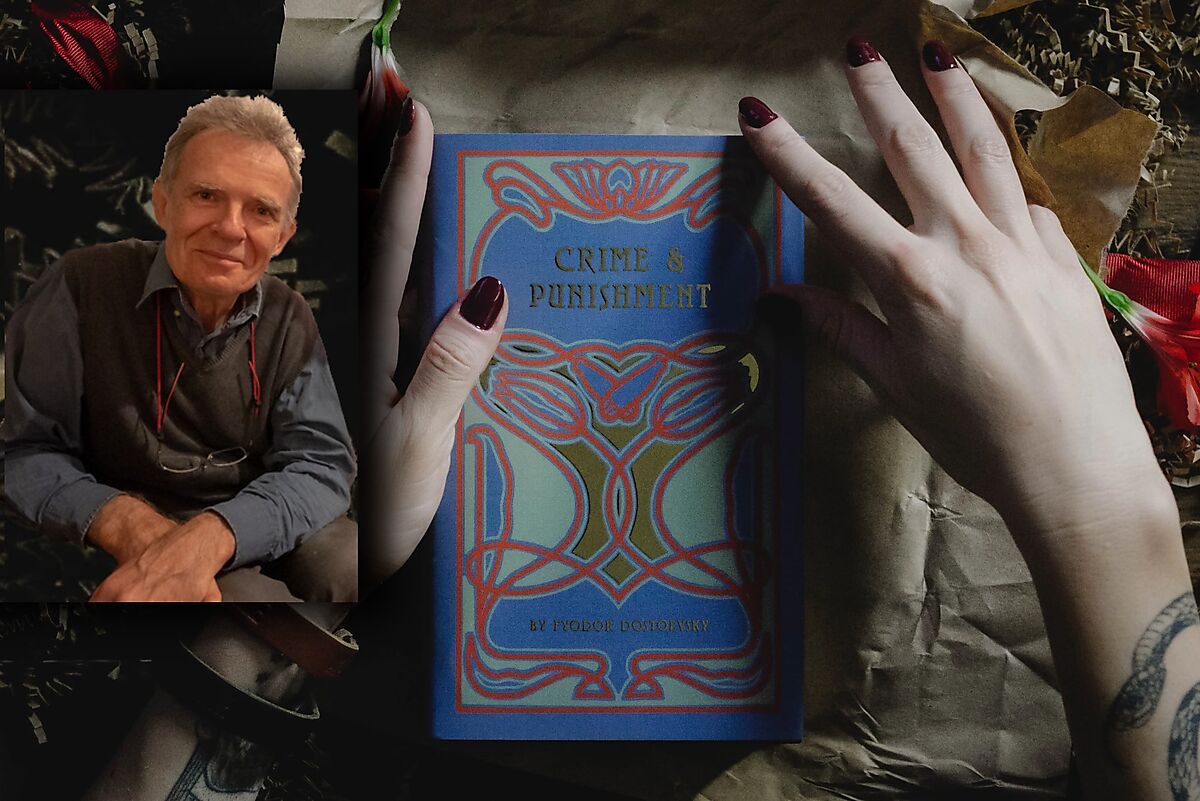
This work, ‘Crime and Punishment & Galen Strawson (inset)’, is a derivative of ‘Galen Strawson 2019’, ‘Crime & Punishment’ used under CC BY. ‘Crime and Punishment & Galen Strawson (inset)’ is licensed under CC BY SA 4.0 by The Cultural Me
Galen Strawson’s Basic Argument — Does Free Will Exist?
In 1993 in Liverpool, England, two ten-year-old boys abducted and murdered two-year-old Jamie Bulger. Could they be held responsible?
According to one view, they were driven by factors beyond their control, their genetic makeup, upbringing... This view, known as hard determinism, is best summarised by Baron d’Holbach, an 18th century French philosopher, who argued that from the moment of birth Nature commands humans to walk a predetermined line on the surface of the earth without their ‘ever being able to swerve from it, even for an instant.’1
An opposing view, known as indeterminism, argues that, while the choices available to an individual are indeed constrained by their personal circumstances, they are always free to choose between alternatives.
Yet in Freedom and Belief (1986)2 the British philosopher Galen Strawson presented a theory, which he called the Basic Argument, by which free will, to the extent it implies true moral responsibility, is impossible, even when an individual is allowed to choose between alternatives. The boys lack free will not only because they did not choose the way they are, their psychological makeup, but because even if they did, one could say their decision is a consequence of a prior self with its own psychological makeup. Thus a further explanation of the origins of the prior self is required.
Through this argument Strawson shows that to be truly morally responsible for one’s actions requires the completion of a never-ending sequence of truly free decisions, in other words, for one to somehow make themselves the way they are.
Casting doubt on whether criminals are morally responsible for their actions undermines the very foundations of the institutions responsible for punishing crime. As such, there is an institutionalised and equally powerful propensity to believe that free will exists and that Bulger’s killers are indeed morally responsible.
Strawson, G.. 2010. Freedom and Belief. Oxford: Oxford University Press
Rami Barhoumi
Cambridge
What we do and the way we are is the result of factors that are beyond our control, therefore we cannot be said to be free and morally responsible for our actions.