
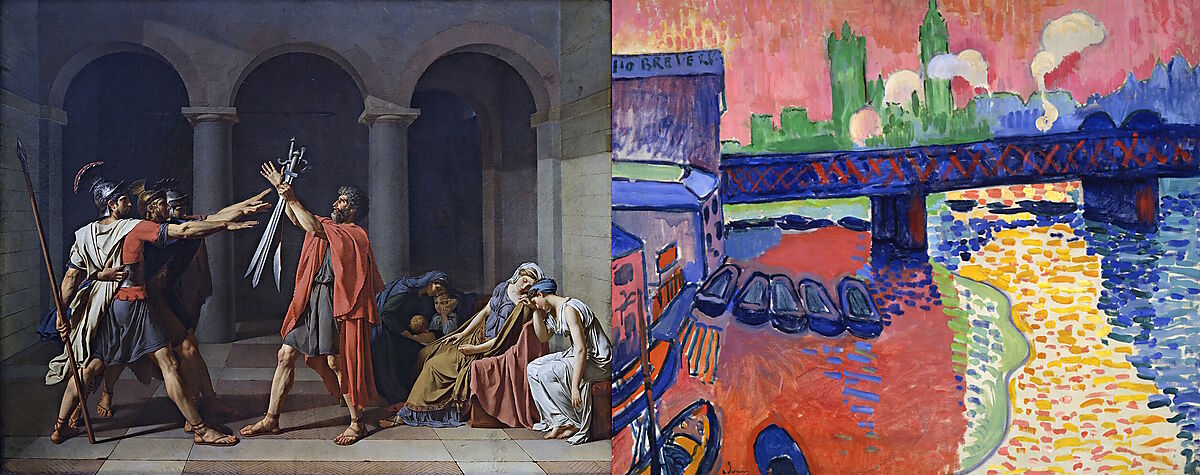
Jacques-Louis David, Oath of the Horatii (1784)/André Derain, Charing Cross Bridge (1906)
From the Fauves to the Salons of Social Media: The Cultural Politics of Colour
The 1905 Salon d’Automne in Paris brought together a striking new generation of painters — Henri Matisse, André Derain, and Maurice de Vlaminck among them — whose works filled one of the exhibition’s side rooms. (A ‘Salon’ in this context refers to a major public art exhibition in France, a tradition dating back to the 17th century.) These vivid paintings, such as Derain’s View of Collioure (1905)1, were displayed alongside a classically styled sculpture by Albert Marque, reminiscent of the Renaissance master Donatello.
When the critic Louis Vauxcelles entered that room, he was taken aback by what he later described as an ‘orgy of pure colours’2. Seeing Marque’s sculpture amid the bright hues, he exclaimed, ‘Donatello parmi les fauves!’ (‘Donatello among the wild beasts’). Thus the Fauves were born.
The Salon d’Automne itself had been founded only two years earlier, in 1903. It was conceived as a space for experimentation and dissent — a venue where artists excluded from the establishment could exhibit on their own terms. Its founding was in deliberate contrast to the official Salon des Beaux-Arts, the state-run exhibition that had dominated French artistic life since the 17th century. The official Salon originated under Louis XIV’s royal patronage in 1667, when it held its first exhibition in the Salon Carré of the Louvre and, after an irregular beginning, became a biennial and later annual event.3
Its ethos was influenced by Enlightenment ideals and Neoclassicism — a style that emerged in the mid-18th century as a reaction against the frivolity of Rococo, drawing inspiration instead from the art and architecture of ancient Greece and Rome. In his essay Reflections on the Imitation of Greek Works in Painting and Sculpture (1755), Johann Winckelmann praised the ‘noble simplicity and sedate grandeur’4 of Greek art, establishing it as a model for modern artists to emulate. Half a century later, Goethe’s Theory of Colours (1810) reinforced this hierarchy by associating vivid hues with the tastes of ‘uncivilized nations and children’5. Together, these ideas laid the intellectual foundations for what became known as Academic Art.
Codified through the teaching practices and juried exhibitions of the Académie des Beaux-Arts, Academic Art favoured subjects drawn from history, religion, and mythology, painted with realistic proportion, balanced composition, and an earthy, limited palette. This aesthetic is epitomised in Jacques-Louis David’s Oath of the Horatii (1784), whose neutral tones, Doric setting, and moral theme of civic virtue exemplify the authority and order that Academic taste sought to uphold.
By the late 19th century, the authority of Academic Art had begun to falter as a new generation of artists challenged its ideals. Independent exhibitions (and later, the Salon d’Automne) championed experiments in colour and light, providing a platform for major movements including Impressionism, Post-Impressionism, and, soon after, Fauvism — each pushing further from the measured discipline of the Academy toward a more subjective vision of reality.
At the forefront of Fauvism were Henri Matisse, André Derain, and Maurice de Vlaminck. Matisse, born in Cambrai in northern France, discovered painting while recovering from an appendicitis attack and later described the experience as finding ‘paradise’67. He left for Paris to study art, but soon grew frustrated with the rigid methods of academic training. A visit to Saint-Tropez in 1904 exposed him to the brilliant light and colours of the French Riviera, awakening a fascination that would transform his oeuvre.
The following summer, Matisse travelled to Collioure, a fishing town near the Spanish border, to work with his friend Derain; soon the Mediterranean setting provided the conditions for Fauvist experiments in colour. Derain, who had defied his father’s wish that he become an engineer8, found in this collaboration a freedom equal to Matisse’s. Their partnership was soon joined in spirit by de Vlaminck, another Paris-area painter determined to overturn convention. For all three, colour became a declaration of independence — a means of breaking free from the muted tones and moral certainties of Academic Art.
In Derain’s Charing Cross Bridge (1906), the cityscape of London remains recognisable, yet its colours defy reality. The sky is peach; the river a patchwork of red, blue, and yellow; the distant buildings soften into tones of green and blue. These choices reflected the artist’s emotional state: a translation of perception into feeling. Rather than using colour to imitate the world, Derain sought to reconstruct it through sensation. In this, the work embodies the central principle of Fauvism: the liberation of colour from its descriptive or naturalistic role.
More than a century later, similar aesthetic tensions surface in our own ‘salons’ of social media. By the mid-2010s, a sleek, hyper-curated minimalism began to emerge on platforms like Instagram and Pinterest: inspirational quotes, pale interiors, and a restrained palette of white, grey, and beige. The goal was to project an ideal life: composed, prosperous. Reality star Lauren Conrad embodies this aesthetic: Breton stripes (the classic French sailor look), a beige trench coat, grey bunting above the fireplace, a morning coffee arranged just so. In one post, she poses in a cream blouse beside a simple perfume bottle — monochrome, classical, almost Grecian in its restraint.
Yet, as with the Fauves a century earlier, a counter-movement soon emerged, one that favoured exuberance over control. Bright colour returned through what came to be called dopamine dressing (a popular term for fashion that boosts one’s mood through colour and contrast). Gen Z (born roughly 1997–2012) rejected the muted minimalism of millennials (born 1981–1996), finding expression in Weird Girl Style: quirky, chaotic, and unashamedly personal. The Canadian stylist and designer Sara Camposarcone typifies this spirit, appearing in lettuce-leaf earrings, cartoon-print dresses, and a clutch shaped like a ketchup packet.
Thus, the way we use colour is never merely a matter of style, rather it reveals deeper cultural attitudes towards order, expression and identity.
The opposition between Fauvism and Academic Art expressed a long-standing tension between discipline and freedom, control and emotion. The Fauves’ bold hues defied the Academy’s muted palette and moral certainties, transforming colour from a tool of representation into a medium of expression in its own right. In their canvases, colour became the end itself — rather than merely the means to an end.
A similar dynamic unfolds in contemporary aesthetics. The pale, minimalist tones of the 2010s reflected a cultural preference for order, curation, and self-control, while the exuberant brights of the 2020s celebrate multiplicity and self-invention. Colour thus becomes a lens through which we can trace the changing values of modern culture.
Although the Fauvist movement was short-lived, its impact proved enduring. By 1910, its leading figures had already diverged in style: Matisse turned toward decorative abstraction and paper cut-outs; Derain and de Vlaminck adopted darker, more muted palettes, as seen in works such as Derain’s Drinker (1913) and de Vlaminck’s The Clearing at Valmondois (c.1912). Yet their early experiments with colour left an indelible mark on modern art. Their discovery of the expressive potency of colour had a profound impact on German Expressionism and laid the foundations for Abstract Art. Artists as varied as Wassily Kandinsky, Marc Chagall and David Hockney would later draw upon their example, treating colour as an autonomous language of emotion and form.
And today, as the exuberance of maximalism returns to fashion and design, the spirit of 1905 and the Fauves resurfaces once more — a reminder that our pursuit of beauty still hinges on the balance between order and chaos.
References
- Unknown Author. "Salon d'automne 1905 catalogue, page 65". Smithsonian. 1905
- Louis Vauxcelles. "Le Salon d'automne". Gil Blas. 1905
- Amy M. Schmitter. "Representation and the Body of Power in French Academic Painting". Journal of the History of Ideas. 63, no. 3. 2002. pp. 400-410. p. 401
- Johann Winckelmann. Reflections on the Imitation of Greek Works in Painting and Sculpture. English Translation by Henry Fusseli: London. 1765. p. 30
- Johann Wolfgang von Goethe. "Theory of Colours, page 326, section 835". Project Gutenberg. 1840
- Hilary Spurling. The Unknown Matisse: A Life of Henri Matisse, the Early Years, 1869-1908. Knopf Publishing Group: New York. 1998. pp. 43-46
- Hilary Spurling. The Unknown Matisse: A Life of Henri Matisse, the Early Years, 1869-1908. Knopf Publishing Group: New York. 1998. p. 46
- Elizabeth Cowling, Jennifer Mundy. On Classic Ground: Picasso, Léger, de Chirico and the New Classicism, 1910-1930. Tate Gallery: London. 1990. p. 46

Of all the great artistic movements, none has inspired me quite like Fauvism. Its striking colours and playful compositions capture a childlike wonder, yet pulse with a defiant spirit that still delights and intrigues. Whether consciously or not, Fauvism continues to influence my own art practice, fashion sense, and decor. This article is an homage to the great Fauvists and to all the artists, artisans, and designers who walk the same cramped yet colourful path.— Megan Stockhill