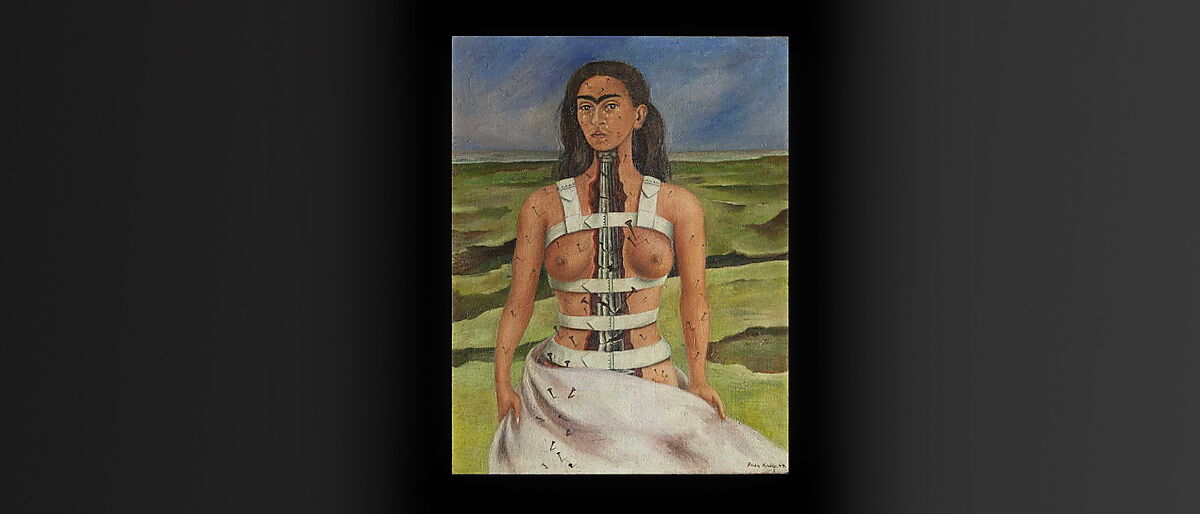
This is a low resolution image of the copyright work ‘The Broken Column (1944)’ by Frida Kahlo owned by Banco de México and INBAL Mexico displayed under Fair Use for criticism or review
Frida Kahlo’s ‘The Broken Column’ — Framed in Surrealism, Rooted in Reality
On 17 September 1925 in Mexico City two young lovers were on their way home from school when a tram crashed into their bus.
Frida Kahlo sustained a litany of injuries including a fractured spine, a shattered pelvis and a broken foot. She painted The Broken Column (1944) after an operation on her spine, just one of 32 she would endure over the next 29 years.1 Post-operative rehabilitation had confined Kahlo to a medical corset, the white leather straps of which are visible.
Kahlo was influenced early on by the European surrealists, and one of its prominent members André Breton visited Kahlo and her husband Diego Rivera in 1938, staying at their home, La Casa Azul (The Blue House).2 Although Kahlo rejected the surrealist label, elements of surrealism, such as the illogical depiction of her body, underpin The Broken Column. However, it is not a fictive dreamscape but an image of Kahlo’s experience of living with pain. In her own words
I never painted dreams. I painted my own reality.”3
In the painting, a crumbling Ionic column represents her damaged spine. Kahlo stands alone in a desolate landscape, wrapped in a bed sheet, her skin painfully studded with nails. Kahlo is a physical ruin; a wreckage of her former self. Luminescent tears fall from her eyes, yet a deep stoicism emanates from her very expression.
Following her death in 1954, Kahlo has become an icon of suffering. Her articulation of the inexpressible torment of hospitalisation and pain, although framed in surrealism, is rooted in reality. So much so that her art has been commended as a tool for understanding patients suffering chronic pain.4
I visited the V&A’s exhibition ‘Frida Kahlo: Making Her Self Up’ in the summer of 2018 and left feeling incredibly disappointed and rather angry. I thought that the curation of the exhibition underplayed the presence of pain and disability in Kahlo’s work, instead choosing to focus on the more ‘palatable’ aspects of her oeuvre.