
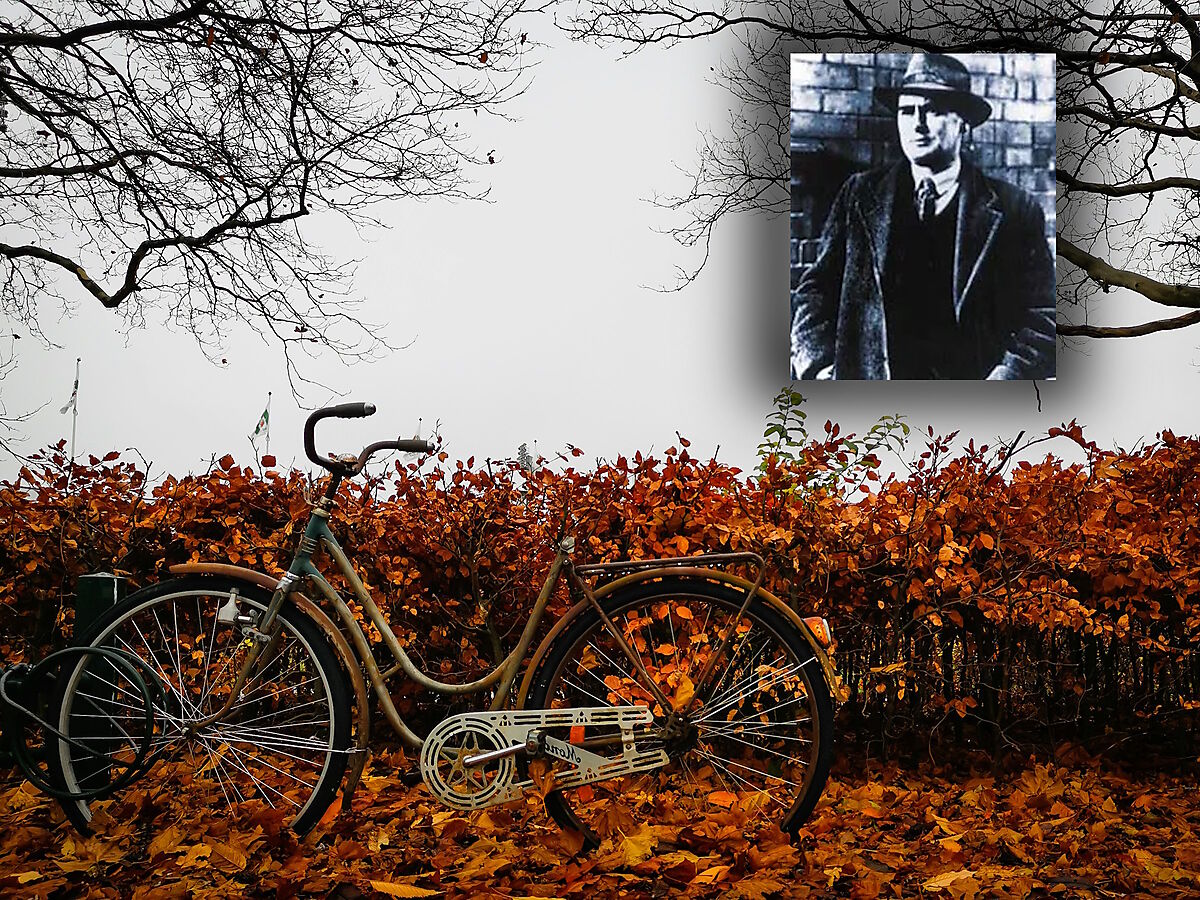
Bicycle; Flann O’Brien (Inset)
Flann O’Brien’s ‘The Third Policeman’ (1939–40) — Colonial Legacy and Stasis in Post-Independence Ireland
In Flann O’Brien’s The Third Policeman (1939–40) the narrator and a co-conspirator, John Divney, murder a man for a cash box. After the crime, John takes the cash box and hides it in an unknown location, keeping its whereabouts a secret. The narrator then becomes inseparable to John, even to the extent of sharing a bed with him. Eventually John discloses that he has hidden the cash box beneath the floorboards of an old house. The narrator sets off to recover it, but the moment he touches the box he is transported to a rural police station in an alternate reality.
O’Brien was born Brian O'Nolan on 5 October 1911 in Strabane, County Tyrone, Ireland. In 1937, when he was 26, his father's death left him partially responsible for supporting his mother and eleven siblings. A recent recruit into the civil service, O’Brien began his career at a time when Ireland was undergoing the lengthy process of separating itself from the British Empire. This period would span 27 years, beginning in 1922 with Ireland being declared a ‘free-state’, and ending in 1949 with the official declaration of Irish independence1.
During the years of colonisation, British rule had eroded Irish language and cultural identity, replacing the native Gaelic with English. The Gaelic Revival was a movement that arose to reinstate Irish national identity and heritage. One outcome of this was a renewed interest in the Gaelic language. O’Brien himself, in order to obtain his position in the civil service, was required to pass an Irish spoken-language test2.
This move towards a country that felt more authentically Irish, however, was not entirely resolved by this focus on language. The systems with which local government operated remained unreformed. As an administration officer O’Brien’s first duty was to become adept at using the jargon in which all official responses were required to be composed3. Written documents were phrased in a formulaic and convoluted manner, which often made them unintelligible to the untrained. O’Brien also found that progression within the civil service itself was not forthcoming, which added to his personal feeling of stasis.
On the economical front, Britain had developed Ireland as an agricultural economy, neglecting industrial growth and leaving the country with relatively low levels of industrialisation and high levels of rural poverty. One visible sign of the lack of infrastructure was the proliferation of bicycles, which were often the only mode of transport in rural areas4.
In O’Brien’s The Third Policeman, upon being magically transported, our narrator arrives at a police station in a land that visually resembles rural Ireland. Immediately he is approached by a police sergeant who asks, ‘Is it about a bicycle?’5 When he answers in the negative, our narrator is met with shock and bewilderment, which only increases when he reveals that he is neither there to report a bicycle theft nor did he arrive at the station on one. Instead he reports a stolen watch which leaves the policeman wondering aloud ‘why should anybody steal a watch when they could steal a bicycle?’6 Even after much insistence from the narrator that there is nothing linking him to a bicycle, the policeman remains convinced that he must be mistaken, stating ‘Never in my puff did I hear of any man stealing anything but a bicycle when he was in his sane senses.’7
In a characteristically surreal turn of events, the narrator ends up accompanying some policemen investigating such a crime. They soon solve the case of the missing bicycle and surprised by the ease of this, our narrator asks:
‘Did you know where the bicycle was?’
‘I did’
‘How?’
‘Because I put it there.’
‘You stole the bicycle yourself?’
‘Certainly.’8
At this point it becomes clear that the policemen are the perpetrators of much of the crime in the region which they then solve in a never-ending cycle.
Through The Third Policeman, O’Brien satirises Ireland’s colonial legacy. The lack of choice surrounding transport in rural Ireland, symptomatic of Britain’s minimal investment in infrastructure, is mocked through the policemen’s obsession with bicycles.
When the narrator disrupts the status quo of bicycle-related crimes by reporting a stolen watch, the policemen are left unsettled. Their response demonstrates an unwavering commitment to maintaining routine practices, echoing the reluctance of postcolonial officials to break with colonial processes. By making the policemen themselves the perpetrators of bicycle theft, O’Brien suggests that those in authority may have been complicit in maintaining this stasis in post-independence Ireland.
Towards the end of the novel, our narrator attempts to escape on a bicycle only to find that he is inexplicably returned back to the police station. The use of a bicycle to convey the novel’s circular structure is particularly apt, as its two wheels evoke the infinity symbol, which like the circle has no beginning or end. The narrator is duped into a sense of escape by bicycle, which mirrors the illusion of progress that O’Brien witnessed in post-independence Ireland. Instead he saw a closed circuit, in which a reality that could have died with Ireland’s colonial past appeared to be repeating ad infinitum.
As well as his role in the civil service O’Brien worked several other jobs, under various pseudonyms, including columnist for the Irish Times — a role he used as an outlet for his mocking commentary on Irish municipal affairs. However, in his later years he found himself frequently in difficulty. He drank heavily, referring to his local pub as his ‘office’9. As a result of declining physical health he was also often absent from work. Despite his use of a pseudonym to critique his employers, it was widely known that he was the author of the weekly column. Eventually, his satire caused enough offence and he was sacked from his job at the civil service. Deprived of this income, he became reliant on writing and experienced a remarkably productive period, despite struggling with ill health. He died of cancer on April Fool’s Day 1966, and a year later The Third Policeman was published.
References
- Ian McCabe. "Leaving the Commonwealth". 20th Century/Contemporary History. 6, no. 4. 1998. 1-6. p.2
- Joseph Brooker. "Estopped by Grand Playsaunce: Flann O’Brien’s Post-colonial Lore". Journal of Law and Society. 31, no. 1. 2004. 1-24. p.19
- Martin Maguire. "A distasteful milieu: Brian O’Nolan and the Civil Service, 1935-51". Journal of Flann O’Brien Studies. 6, no. 1. 2022. 1.18. pp.1-18
- Flore Couloma. "Cycling in Circles: Flann O’Brien’s Free-wheeling Stories in ‘The Third Policeman". International Journal of the History of Sport. 29, no. 12. 2012. 1715-1728. p.1716
- Flann O’Brien. The Third Policeman. London: Harper Perennial. 2007. p.57
- Flann O’Brien. The Third Policeman. London: Harper Perennial. 2007. p.63
- Flann O’Brien. The Third Policeman. London: Harper Perennial. 2007. p.63
- Flann O’Brien. The Third Policeman. London: Harper Perennial. 2007. pp.84-85
- Anne Clune. "O'Nolan, Brian (‘Flann O'Brien’)". Dictionary of Irish Biography. 2009

I first became interested in Irish history through the film The Wind that Shakes the Barley (2006), which opened my eyes to this nation’s struggle for self-governance. Later I was struck by the startlingly experimental literature of Irish writers such as James Joyce and Samuel Beckett. Fascinated by this combination of tumultuous political history and literary innovation, I chose to complete a module on Irish fiction at university — which is where I first encountered The Third Policeman.— Alex Jamieson