
Factory Act 1850
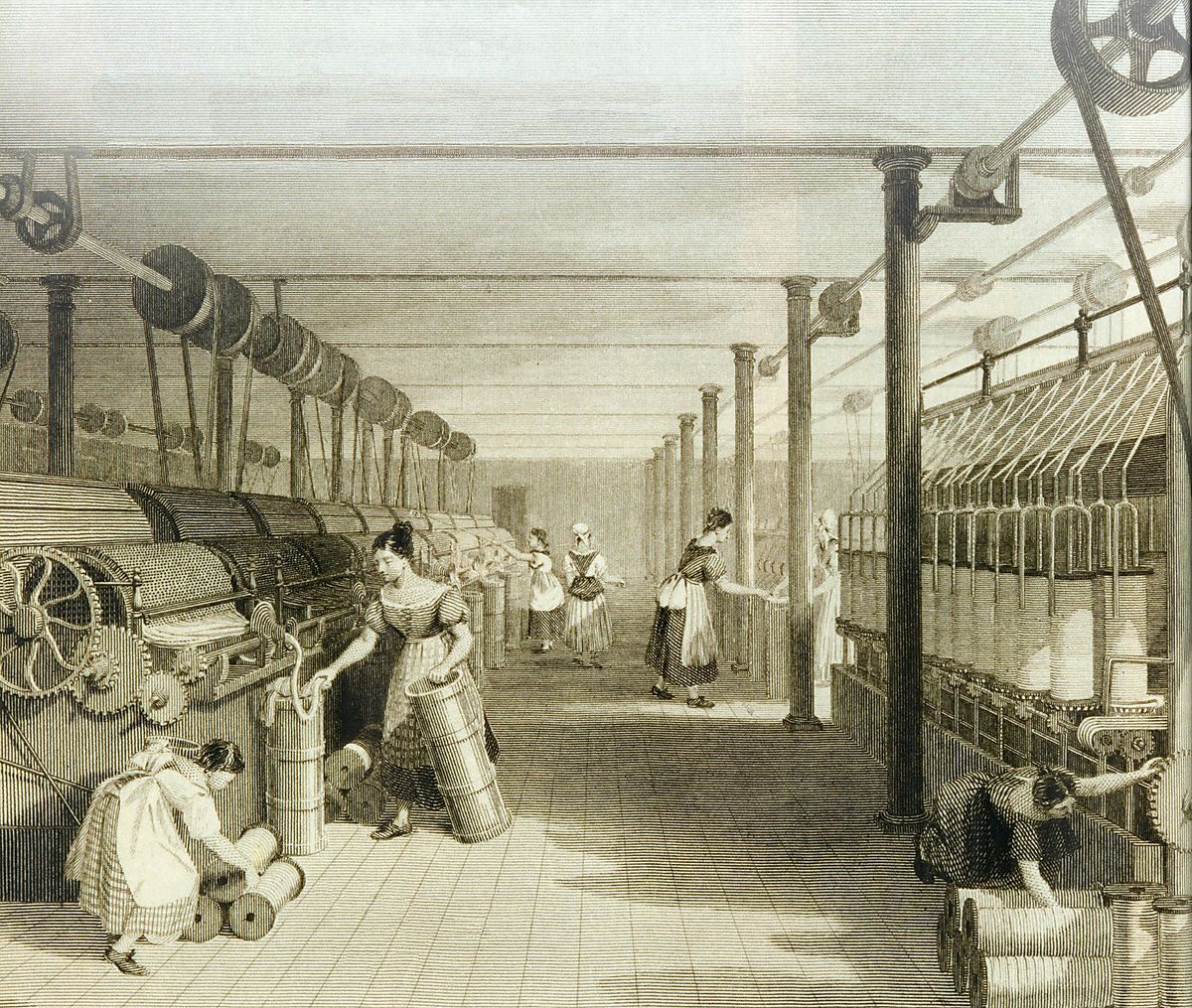
Cotton mill in the 1830s.
The Factory Acts were a series of UK labour law Acts passed by the Parliament of the United Kingdom to regulate the conditions of industrial employment.
The early Acts concentrated on regulating the hours of work and moral welfare of young children employed in cotton mills but were effectively unenforced until the Act of 1833 established a professional Factory Inspectorate.
The regulation of working hours was then extended to women by an Act of 1844. The 1847 Factories Act (known as the Ten Hour Act), together with Acts in 1850 and 1853 remedying defects in the 1847 Act, met a long-standing demand by the millworkers for a ten-hour day.
The Factory Acts also sought to ameliorate the conditions under which mill-children worked with requirements on ventilation, sanitation, and guarding of machinery.
The key provisions of the 1850 Act were: Women and young persons could only work from 6am to 6pm (7am to 7pm in winter). All work would end on Saturday at 2 pm.
The early Acts concentrated on regulating the hours of work and moral welfare of young children employed in cotton mills but were effectively unenforced until the Act of 1833 established a professional Factory Inspectorate.
The regulation of working hours was then extended to women by an Act of 1844. The 1847 Factories Act (known as the Ten Hour Act), together with Acts in 1850 and 1853 remedying defects in the 1847 Act, met a long-standing demand by the millworkers for a ten-hour day.
The Factory Acts also sought to ameliorate the conditions under which mill-children worked with requirements on ventilation, sanitation, and guarding of machinery.
The key provisions of the 1850 Act were: Women and young persons could only work from 6am to 6pm (7am to 7pm in winter). All work would end on Saturday at 2 pm.
Factory Acts adapted from Wikipedia and licensed by The Cultural Me under CC BY SA 3.0