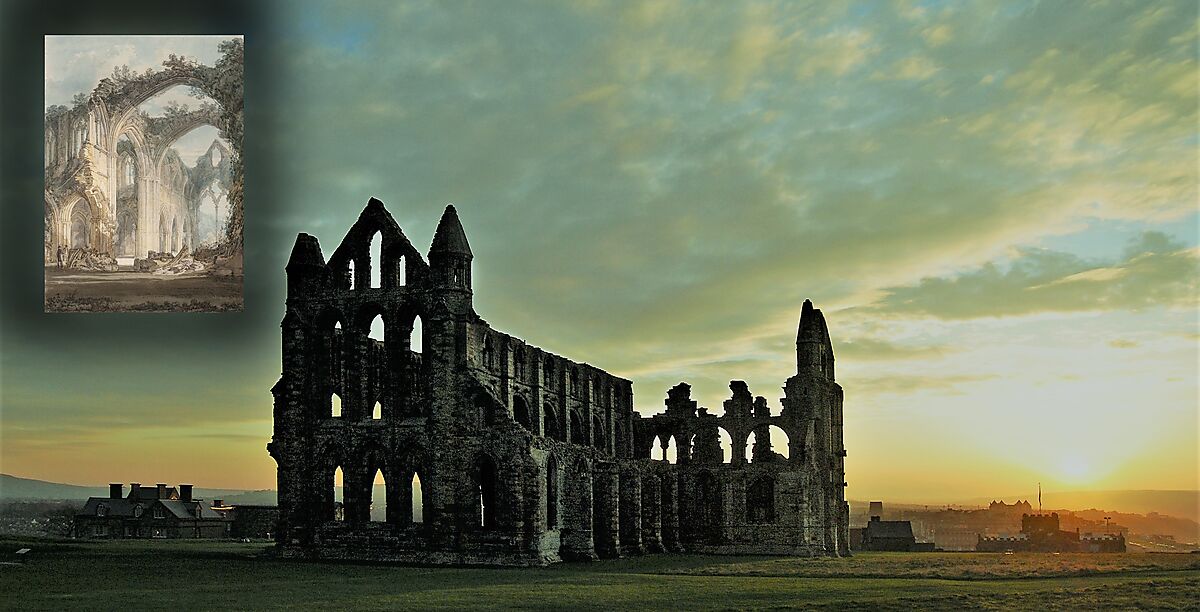
High on a Yorkshire headland overlooking the North Sea stands the ruins of Whitby Abbey, a 7th century monastery. It was destroyed in 1540 along with over 800 other religious institutions during Henry VIII’s Dissolution of the Monasteries (1536–1541), as he wrested control from the Pope.
The King’s men stripped the buildings of their leadwork, bells and other valuables, and ensured they were uninhabitable, but did not demolish them completely. Demolition was an expensive undertaking, but the ruins may also have acted as a Protestant symbol to quell dissent.1 To Catholics they were proof of Protestant profanity — cause for mourning and mobilisation to restore Papal rule in England.2
Over time, the interpretation of England’s ruined monasteries became more secular. From the 17th century, these visible ruptures with the past awakened a historical consciousness. The antiquarian John Weever’s Ancient Funerall Monuments (1631), which records the monasteries’ lives before the Dissolution, helped to keep their memory alive.3
A century-and-a-half later, JM Turner painted the watercolour Tintern Abbey (1794). By this time the ruined monasteries had been absorbed into the Romantic aesthetic, known for its melancholy and Gothic style. To these poets and artists, the ruins were timeless mementoes of human mortality and, for the first time, they began to be regarded as beautiful because of their decay.4
In the 20th century, England’s ruined monasteries have become iconic, their Gothic silhouettes gaining international exposure through film and photography.
As for Whitby Abbey, Irish writer Bram Stoker assured its fame by setting his novel Dracula (1897) there, helping to turn it into a popular film location5 — an outcome antithetical to Henry VIII’s desire to consign monasteries to the past
Walsham, Alexandra. The reformation of the landscape: Religion, identity, and memory in early modern Britain and Ireland. Oxford: Oxford University Press. 2011
Walsham, Alexandra. The reformation of the landscape: Religion, identity, and memory in early modern Britain and Ireland. Oxford: Oxford University Press. 2011
Aston, Margaret. English Ruins and English History: The Dissolution and the Sense of the Past. Journal of the Warburg and Courtauld Institutes, vol. 36. 1973. 231–255
Dwyer, John. Ruins and the embrace of nature. Australian Garden History 21.2. 2009. 10-14
Ruins may not strike us as a purposefully constructed part of our landscape, but when an edifice is left partly standing (when its materials could easily be used for other purposes) there is creative intention at work. At the time, one’s theological perspective influenced how one interpreted them, but now most of us are products of Romanticism whether we are aware of our cultural inheritance or not.