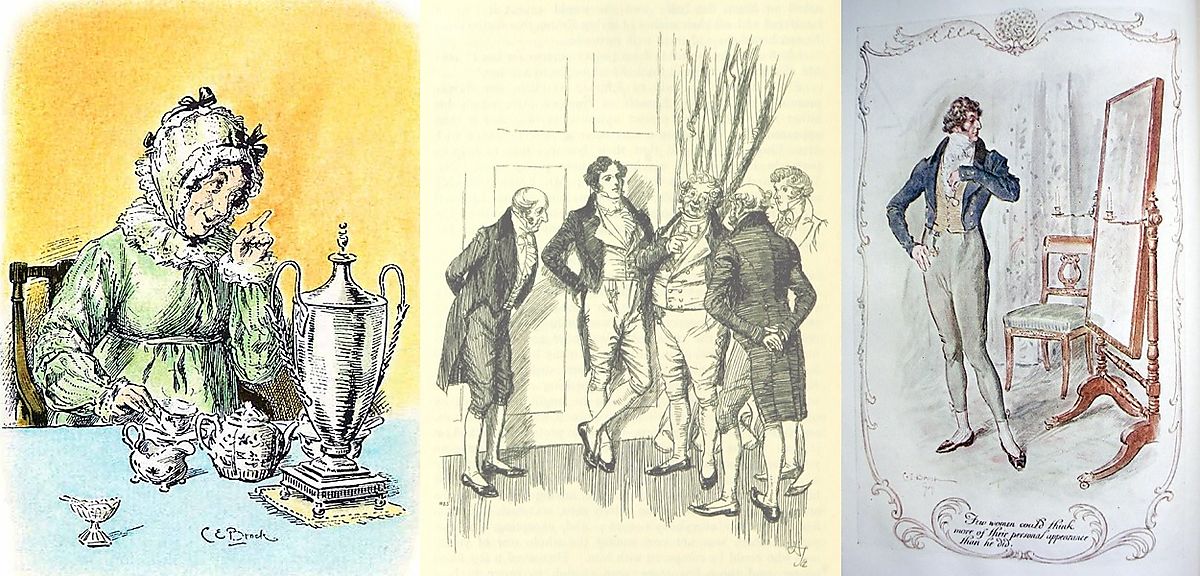
Jane Austen’s Mrs Bennet, Mr Woodhouse and Sir Walter Elliot
This work, ‘Jane Austen’s Mrs Bennet, Mr Woodhouse and Sir Walter Elliot’, is a derivative of ‘Mrs Bennet’, ‘Emma: Among the bulky forms’, ‘Sir Walter Elliot’ used under CC BY. ‘Jane Austen’s Mrs Bennet, Mr Woodhouse and Sir Walter Elliot’ is licensed under CC BY SA 4.0 by The Cultural Me
Emotionally Absent Parents in Jane Austen’s Novels
In Jane Austen’s Persuasion (1817), Sir Walter Elliot holds the startling view that ‘his two other children were of very inferior value.’1 However, Sir Walter is not alone in being a disinterested parent in Austen’s novels.
Readers revel in Mr and Mrs Bennet of Pride and Prejudice (1813). Mr Bennet has some of the best lines in the novel, but they also reveal his flaws as a parent. ‘Lydia will never be easy till she has exposed herself in some public place or other,’2 he says wittily, before allowing her on a disastrous trip to Brighton.
Mrs Bennet’s quest to find suitable husbands for her brood of daughters makes for excellent comedy—if not parenting. According to the narrator, she is ‘of mean understanding, little information, and uncertain temper’3, never demonstrating any empathy for her daughters’ true feelings. Her exuberant and hypocritical reaction to the news of her daughter Elizabeth’s engagement to the wealthy Mr Darcy leaves Elizabeth thankful that her mother’s ‘effusion was heard only by herself.’4
While Mr and Mrs Bennet are absent emotionally, they are physically very—in some cases embarrassingly—present. Paradoxically, parents who seem to be admirable are those who are usually physically absent. Persuasion’s heroine Anne Elliot and Emma Woodhouse of Emma (1815) are both motherless, raised by their respective fathers, the vain Sir Walter Elliot and the indulgent Mr Woodhouse. But there are hints that their late mothers provided valuable early guidance.
The ‘light, bright and sparkling’5 nature of Jane Austen’s novels is rightly much admired. Equally deserving of admiration are her heroines, who triumph despite disinterested or absent parents, rather than because of them.
I’m a lifelong fan of Jane Austen and her heroines. While they are inherently flawed, they share admirable characteristics of integrity and altruism. When I thought about where those characteristics had come from, it became clear to me that they were unlikely to have been instilled by their parents.