
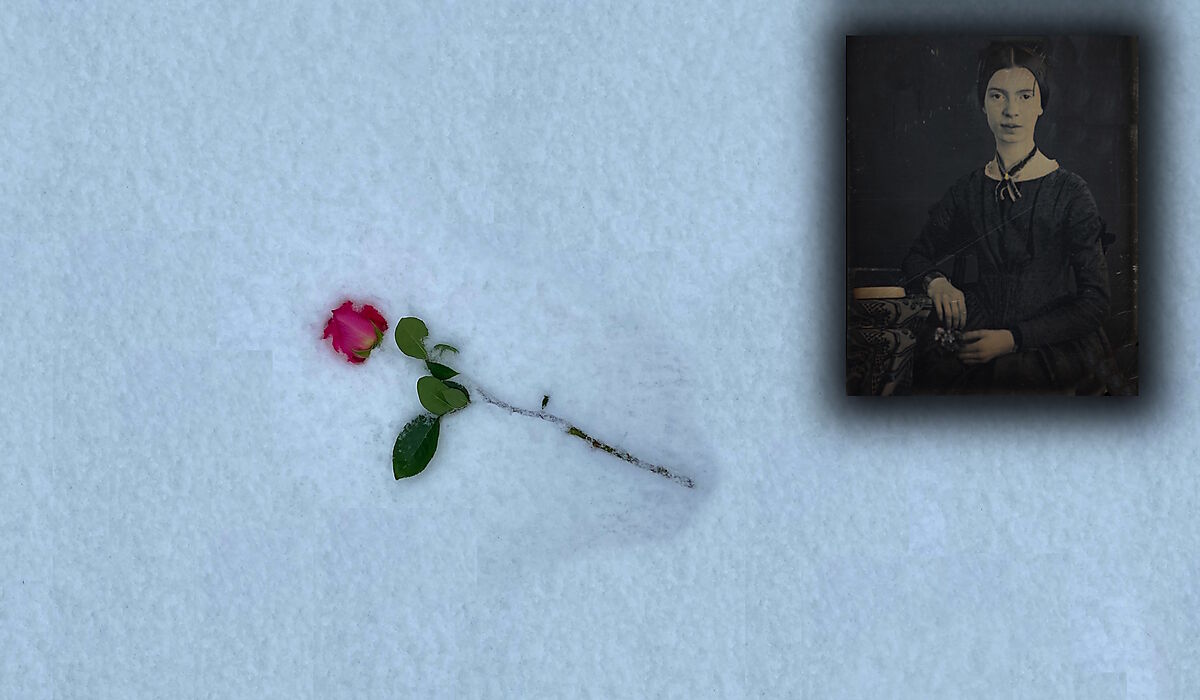
A Fallen Rose; Emily Dickinson c 1847 (inset)
Emily Dickinson’s ‘Apparently with no surprise’: A Poetic Rejection of Predestination and Mortality
Emily Dickinson’s cache of nearly 1,800 poems was discovered by her sister only after her death in May 1886. Several of these poems were later published in three posthumous collections between 1890 and 1896.
Dickinson was born in Amherst, Massachusetts, USA in 1830 to a prominent Calvinist Christian family.
Calvinism, which originates from the works of the French theologian John Calvin (1509–1564), is deeply rooted in the doctrine of predestination — the belief that God has preordained the fate of every individual, regardless of their actions on Earth. Central to Calvinism is the notion of ‘double predestination’ which holds that God predestined some, the ‘elect’, to eternal salvation, and others, ‘the reprobates’, to eternal damnation.1 Within this framework, human actions on earth cannot influence salvation, as divine grace is solely at God’s discretion; however, good actions hold significance as evidence of God’s grace in the lives of the elect. Death too is not seen as a tragic event, but rather a part of God’s predetermined plan. Calvinists are thus expected to ‘moderate’ their grief2, finding solace not in emotional expression, but in their unwavering faith in God.
In 1844, when she was 13, Dickinson was left traumatised by the death of her second cousin and close friend Sophia Holland.3 This loss had a profound effect on Dickinson’s Christian beliefs. Unlike her peers, she neither undertook a profession of faith, as was customary, nor formally joined the church. She continued to attend services regularly in the mid-1840s, but had stopped by 1852, writing: ‘Some keep the Sabbath going to Church — I keep it, staying at Home’4, a stance that prompted her to later refer to herself as a pagan.5
By the time she was 30, Dickinson had withdrawn from public life, choosing to maintain contact with others almost exclusively through letters. Her nieces, nephews, and local children were among the few visitors she permitted. Mac Jenkins, the son of family friends, later recounted her care and affection for them in his 1891 article, A Child’s Recollection of Emily Dickinson.6 Her active engagement with children perhaps brought her solace from bereavement; by 1883, she had endured the loss of several close friends, her beloved dog, both parents, and her favourite nephew, each to unrelated causes.
During her formative years, Dickinson was also influenced by the American Romantic Movement, an artistic and intellectual movement inspired by European Romanticism. Like its European counterpart, American Romanticism emphasised individualism, moral enthusiasm, reverence for nature and the sublime, and the celebration of human emotion as an authentic source of aesthetic expression. Many American Romantics sought freedom from religious tradition, specifically critiquing the ‘harsh, rigid’ dogma of Calvinism.7
Sometime around 1880, Dickinson penned ‘Apparently with no surprise’, an eight-line poem:
Apparently with no surprise [8 syllables]
To any happy Flower [7 syllables]
The Frost beheads it at its play [8 syllables]
In accidental power [7 syllables]
The blonde Assassin passes on [8 syllables]
The Sun proceeds unmoved [6 syllables]
To measure off another Day [8 syllables]
For an Approving God [6 syllables]
The poem mimics a hymn meter form, shifting between iambic tetrameter (four metric feet per line; 8 syllables) to an iambic trimeter (three metric feet per line; 6 syllables), initially with a feminine ending (an unstressed final syllable). Here, life as personified by the ‘happy Flower’ is brutally beheaded by frost. The ‘Assassin’, the frost, takes the flower in ‘accidental power’, underscoring the unpredictable force of existence — the spontaneity of death without malice.
The blondness of the frost-assassin evokes the image of the sun reflecting off a snowy landscape, in turn signalling the frost’s impending death as it melts and ‘passes on’; no one is spared the inevitability of death.
Towards the later half of the poem, the last syllable in the iambic trimeter falls off, introducing a tonal shift that reflects the speaker’s growing shock at nature’s neutrality towards death.
The speaker notes that God ‘approves’ of this early death, reinforcing the image of God’s omniscience and sovereignty. The flower’s innocence has no bearing on its fate; the flower, like the human soul, is at the mercy of God’s unchangeable will.
While the poem accepts death as natural and inevitable, the death of the flower acts as a metaphor for the arbitrary cruelty of a God who enacts suffering with cold indifference. This portrayal critiques the theological underpinning of the natural world, the unconditional election of Calvinism which strips individuals of agency. The speaker’s refusal to blindly accept the morality of death illustrates the complexity of human responses to mortality which contrasts with Calvinism’s expectation of emotional resignation in the face of death.
Within her epoch, Dickinson stands at a crossroads between Christianity and Romanticism. She acknowledges that death is part of God’s ultimate design, but rejects the unquestioning acceptance of fate. While she exalts nature to the stature of God, she also presents it as equally complicit in ending lives impetuously. Through her stance, Dickinson offers a refined approach that challenges a rigid adherence to either Christianity or Romantic ideals.
By writing in a state of tension between these two paradigms, Dickinson’s work resonates with the pursuit of self-actualisation, eventually leading to her becoming an influential and enduring figure in both Romantic poetry and American literature as a whole.
Although she never had any children of her own to carry on her legacy, later editions of Dickinson’s work were published by her niece Martha Dickinson Bianchi and remain in print to this day, a testament to the loyalty of the children she greatly cherished.
References
- John Calvin. Institutes of the Christian Religion, Vol. 2. Book 3.. Philadelphia: Westminster Press. 1960. p.206
- John Calvin. Commentary on Genesis, Vol. 1.. Grand Rapids: Christian Classics Ethereal Library. 2024. p.449
- Thomas W. Ford. Heaven Beguiles the Tired: Death in the Poetry of Emily Dickinson.. Tuscaloosa: University of Alabama Press. 1966. p.18
- Thomas H. Johnson (ed.). The Complete Poems of Emily Dickinson. Boston: Little, Brown and Company. 1960. p.153
- Karl Keller. The Only Kangaroo Among the Beauty: Emily Dickinson and America. Baltimore: Johns Hopkins University Press. 1979. p.79
- Alfred Habegger. My Wars Are Laid Away in Books: The Life of Emily Dickinson.. New York: Random House. 2001. p.547
- George L. McMichael and Frederick C. Crews, 6th edn (ed.). Anthology of American Literature: Colonial Through Romantic. Saddle River: Prentice Hall. 1997. p.613

I have long been fascinated by the gothic and macabre, drawn to the mysterious cycle of life and death. After encountering Emily Dickinson’s poetry in my late teens, I became intrigued by the intersections of the sacred and the unsettling. Her poem ‘Apparently with no surprise’ beautifully captures this blend, exploring the complex relationships between death, fate, and divine will. Writing this article allowed me to delve into how Dickinson’s work unites these realms while also reflecting on my personal relationship with death.— Jemima Seals