
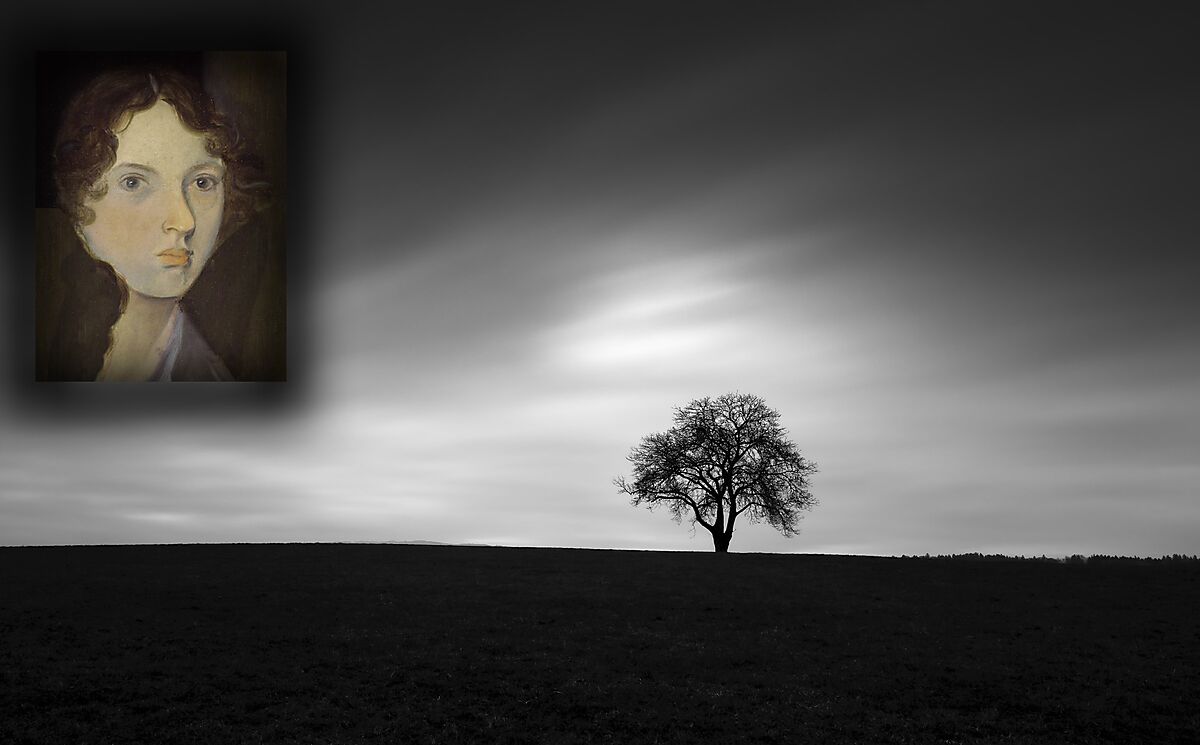
The Yorkshire Moors and Emily Brontë (inset)
Emily Brontë’s ‘Wuthering Heights’ (1847) — A Portrayal of the Inequalities of Marriage for Victorian Women
In Emily Brontë’s Wuthering Heights (1847), Catherine Earnshaw is described as ‘a wild, wick[ed] slip’1 of a girl by housekeeper Nelly Dean. The story is set in rural Yorkshire at the end of the 18th century and explores the arrival of the orphan Heathcliff and its consequences on the Earnshaw and Linton families. Catherine is a child of six when Nelly Dean begins her tale. To Nelly, Catherine is ‘saucy’2 and ‘bold’3, and she observes that one of Catherine and Heathcliff’s ‘chief amusements [was] to run away to the moors in the morning and to remain there all day.’4
Brontë herself was a real-life Catherine of the moors. Raised in a parsonage alongside her siblings in rural Yorkshire by her curate father, Patrick Brontë, Emily ‘loved liberty, she enjoyed passionately the lonely moors, and she loved wild animals because they were wild,’5 and played at retreating into Gondal, an imaginary North Pacific island (invented together with her younger sister, Anne), well into her adulthood6.
Wuthering Heights was published ten years into the reign of Queen Victoria — a period in which there were constraints on women pursuing independent lives. The prospect of employment for women of Brontë’s social standing was limited, with the typical role being that of governess or school teacher. Instead, the Victorian expectation for middle-class women was to enter into an advantageous marriage and pursue a domestic life thereafter; the woman’s role was that of an ‘angel in the house’7, financially dependent on her husband, keeping out of the public sphere, and managing the domestic front.
In addition to Anne, Brontë had four other siblings. The first two children, Elizabeth and Maria, would die of typhoid aged just 10 and 11. Charlotte was the oldest surviving sibling who died aged 38, one year after her marriage. Branwell was an older brother to Brontë, and Anne was the youngest. All three would tragically not live beyond the age of 31 and would die unmarried. Charlotte and Anne would also go on to write successful novels; however, the sisters initially chose to publish their works using male pseudonyms. Charlotte would later write, ‘we did not like to declare ourselves women, because [...] we had a vague impression that authoresses are liable to be looked on with prejudice.’8
In Wuthering Heights, Brontë crafts Catherine Earnshaw as a passionate and headstrong character who is defiant of authority — the opposite of her foil Isabella Linton who is an archetypal Victorian woman, ‘a charming young lady’9 much loved by her family. The Linton family is untitled but wealthy and live in Thrushcross Grange, the plush family home.
Brontë explores Catherine’s gradual realisation of societal expectations upon her during a stay with Isabella and her family — to become ‘the greatest woman of the neighbourhood’10 and to marry suitably. Yet when confronted with marriage to Edgar Linton (Isabella’s brother), she toys with the idea of a union with Heathcliff instead. In comparing their souls, Catherine says of Heathcliff, ‘his and mine are the same, and [Edgar] Linton’s is as different as a moonbeam from lightning, or frost from fire.’11 Almost in the same breath, however, we hear Catherine passionately cry, ‘it would degrade me to marry Heathcliff’12 — a gypsy orphan of low birth and not much fortune.
The turmoil in her soul turns the formerly feisty young woman who was happiest on the heather-strewn moors to one whose spirits are dampened at the prospect of a suitable marriage. Catherine becomes deliriously ill and while lying in her room she cries, ‘I wish I were a girl again, half savage and hardy, and free [...] I’m sure I should be myself [...] among the heather on those hills!’13
The ‘charming’ Isabella Linton, on the other hand, decides to marry Heathcliff, a decision which is denounced by both her brother and Catherine. By marrying Heathcliff Isabella not only surrenders her comfortable life at Thrushcross Grange but also sacrifices her financial independence and freedom for she would then be bound by the laws of coverture. Established as part of English common law, coverture was a legal doctrine according to which after marriage ‘the husband and wife were considered a single entity: the husband’14.
Through the lives of these two women, Brontë sketches a careful critique of the circumstances of women of the time. Catherine must marry for wealth and prestige while Isabella risks losing hers through coverture. The prevailing social and financial strictures, in disallowing women the independence to pursue love or to depart from it, are starkly portrayed. Although the story is set some fifty years earlier to the 1840s, the time when Brontë worked on the novel, the circumstances would have been broadly the same. It was not until the Married Women's Property Acts of 1870 and 1882 that women were able to hold assets and income separate from their husbands, putting an end to coverture.
Wuthering Heights was called ‘a strange book’15 by Examiner upon its release; Douglas Jerrold’s Weekly Newspaper claimed that ‘the women in the book are of a strange fiendish-angelic nature, tantalising, and terrible.’16 However, Brontë’s characterisation was ahead of her time, and the novel is now considered an established classic. Brontë’s ability to create such singular female characters can largely be attributed to her own unique nature, something best described by her sister Charlotte who wrote in the preface to the posthumously published 1850 edition of Wuthering Heights that she had ‘never seen [Emily’s] parallel in anything. Stronger than a man, simpler than a child, her nature stood alone.’17
Unlike many women of her time, Emily Brontë never had a need to become an ‘angel in the house’ becoming financially independent after inheriting money from a late aunt.18
References
- Ian Jack, 4th edn (ed.). Wuthering Heights. Oxford: Oxford University Press. 2009. p.36
- Ian Jack, 4th edn (ed.). Wuthering Heights. Oxford: Oxford University Press. 2009. p.36
- Ian Jack, 4th edn (ed.). Wuthering Heights. Oxford: Oxford University Press. 2009. p.36
- Ian Jack, 4th edn (ed.). Wuthering Heights. Oxford: Oxford University Press. 2009. p.40
- Augustus Ralli. "Emily Bronte: The Problem of Personality". The North American Review. 221, no. 86. 1952. pp. 495-507. p.498
- Augustus Ralli. "Emily Bronte: The Problem of Personality". The North American Review. 221, no. 86. 1952. pp. 495-507. p.498
- Lynda Need. "Women and Urban Life in Victorian Britain". History Trails Victorian Britain. 2004
- Carol Ohmann. "Emily Brontë in the hands of Male Critics". College English. 32, no. 8. 1971. pp.906–913. 906
- Ian Jack, 4th edn (ed.). Wuthering Heights. Oxford: Oxford University Press. 2009. p.89
- Ian Jack, 4th edn (ed.). Wuthering Heights. Oxford: Oxford University Press. 2009. p.69
- Ian Jack, 4th edn (ed.). Wuthering Heights. Oxford: Oxford University Press. 2009. p.71
- Ian Jack, 4th edn (ed.). Wuthering Heights. Oxford: Oxford University Press. 2009. p.71
- Ian Jack, 4th edn (ed.). Wuthering Heights. Oxford: Oxford University Press. 2009. p.111
- The Editors of the Encyclopaedia Britannica. "coverture". Encyclopaedia Britannica. 2007
- Paul Thompson. "Contemporary Reviews of Wuthering Heights". The Reader’s Guide to Wuthering Heights. 2007
- Paul Thompson. "Contemporary Reviews of Wuthering Heights". The Reader’s Guide to Wuthering Heights. 2007
- The British Library. "Charlotte Brontë's 1850 Preface to Wuthering Heights". The British Library. 2019
- Sky History. "Was Emily Brontë a feminist?". Sky History. 2021

After studying Wuthering Heights many years ago, I had a strong desire to revisit the novel and explore the women of the story. My previous analysis of the work had always focused on Heathcliff but this time I wanted to shed light on the important and distinct roles that women play in Brontë’s novel and how they serve to reflect social issues of the time.— Emma Smith BA (Hons)