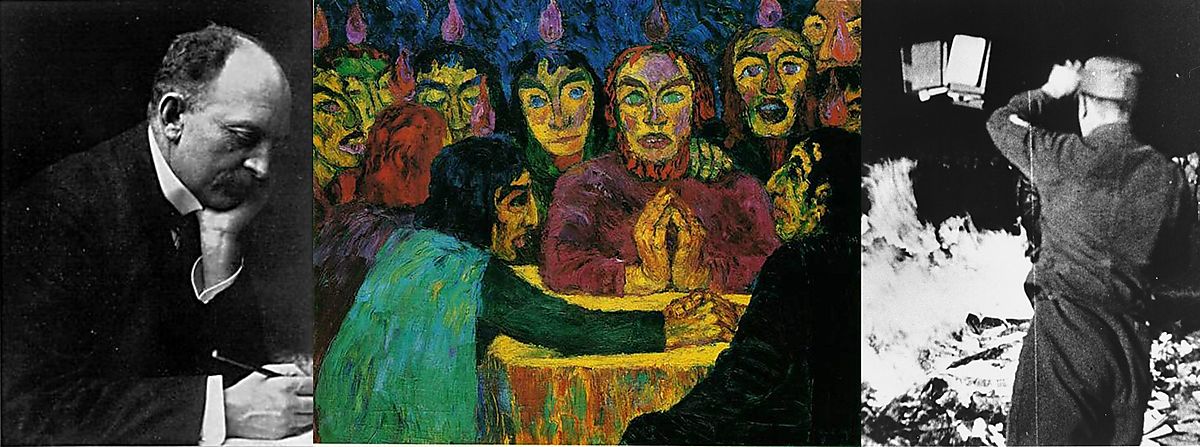
The German painter Emil Nolde (1867–1956) had an immense impact on expressionism with his innovative use of colour.1 Nolde saw colour as the painting’s essence, rather than merely a means of illustration—a radical view even for the progressive expressionists. His Pentecost (1909) is typical of his use of contrasting colours and expressive spontaneity.2
During WW2, despite initially advocating the Nazi Party, Nolde’s work was labelled as ‘un-German’, and 48 of his 1052 confiscated works were displayed at the Entartete Kunst (degenerate art) exhibition of 1937.3 Four years later, Nolde’s paintings were also banned from sales.4
After the war and following his death in 1956, Nolde’s reputation continued to grow, with German chancellor Angela Merkel choosing two of his paintings for the chancellery in 2006.5 Nolde’s stoicism in the face of Nazi persecution was a source of national pride, and his story formed part of the efforts to rehabilitate Germany on the international stage.6
In 2013, following Nolde’s surviving wife’s death, the Nolde estate in Seebüll provided public access to their previously unseen archives.7
Documents containing Nolde’s antisemitic beliefs were discovered, including a de-Judaisation proposal in 1933 for deporting Jews to a separate state.8 It also became clear that Nolde’s public image had been influenced by the previous director, Joachim von Lepel, emphasising Nolde’s persecution by the Nazis,9 whilst removing antisemitic views from his autobiography.10
These revelations have caused a shift in Germany’s perception of Nolde, epitomised by the chancellery’s decision to find replacements for his paintings.
Others have argued for Nolde’s art to be viewed independently of his political affiliations, raising questions on whether it is possible to isolate art from its historical context.11
Averil King. Emil Nolde. Artist of the Elements. Philip Wilson Publishers. 2013. 8-13
Peter Selz. Emil Nolde. The Museum of Modern Art. 1963. 7
Olaf Peters. Degenerate Art. The Attack on Modern Art in Nazi Germany 1937. 2014. Prestel Verlag. 176
Gesa Jeuthe. Kunstwerte im Wandel. Die Preisentwicklung der deutschen Moderne im nationalen und internationalen Kunstmarkt 1925 bis 1955. Akademie Verlag. 2011. 161
Wolfgang Ullrich. Macht zeigen. Kunst als Herrschaftsstrategie. Deutsches Historisches Museum. 2010. 63
Christian Saehrendt. ‘Die Brücke’ zwischen Staatskunst und Verfemung. Expressionistische Kunst als Politikum in der Weimarer Republik, im „Dritten Reich“ und im Kalten Krieg. Franz Steiner Verlag. 2005. 57-59
Bernhard Fulda. Emil Nolde — eine deutsche Legende: Der Künstler im Nationalsozialismus. Essay- und Bildband. Prestel Verlag. 2019. 221-244
Kirsten Jüngling. Emil Nolde. Die Farben sind meine Noten. Propyläen. 2013. 292
When I read about a recent exhibition on Nolde, I knew I wanted to write about how, even after these many decades, the legacy of Germany’s National Socialist Regime continues to be felt. The fact that it was possible for someone to create a myth around Nolde’s persona and maintain it until recently both fascinated and shocked me.