
Emergency Banking Act 1933
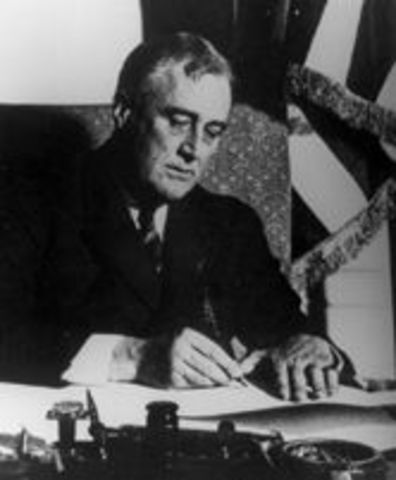
US President Franklin D Roosevelt signing the Bonneville Project Act - 19370820 (B&W)
The Emergency Banking Act (EBA) was an act passed by the United States Congress in March 1933 in an attempt to stabilize the banking system. The EBA was one of President Roosevelt's first projects in the first 100 days of his presidency.
Beginning on February 14, 1933, Michigan declared an eight-day bank holiday. Fears of other bank closures spread from state to state as people rushed to withdraw their deposits. Within weeks, all other states held their own bank holidays in an attempt to stem the bank runs.
The new law allowed the twelve Federal Reserve Banks to issue additional currency on good assets so that banks that reopened would be able to meet every legitimate call.
This act was a temporary response: The 1933 Banking Act passed later that year presented elements of longer-term response, including formation of the Federal Deposit Insurance Corporation (FDIC).
Beginning on February 14, 1933, Michigan declared an eight-day bank holiday. Fears of other bank closures spread from state to state as people rushed to withdraw their deposits. Within weeks, all other states held their own bank holidays in an attempt to stem the bank runs.
The new law allowed the twelve Federal Reserve Banks to issue additional currency on good assets so that banks that reopened would be able to meet every legitimate call.
This act was a temporary response: The 1933 Banking Act passed later that year presented elements of longer-term response, including formation of the Federal Deposit Insurance Corporation (FDIC).
Emergency Banking Act adapted from Wikipedia and licensed by The Cultural Me under CC BY SA 3.0