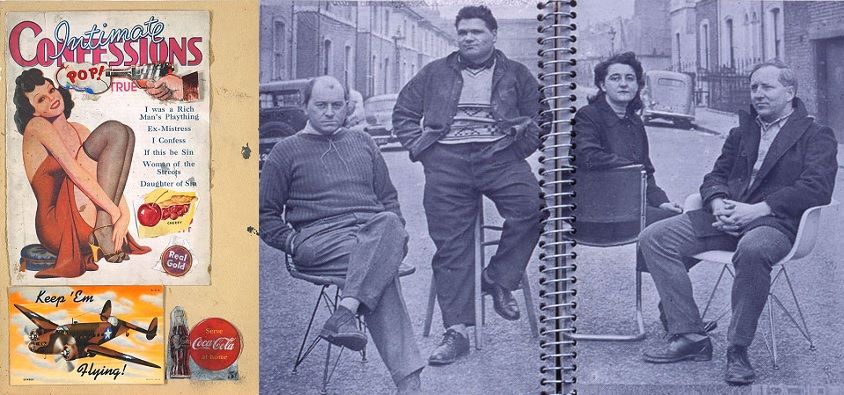
An influential art movement of the 20th century was sparked off by the childhood pastime of a boy born to Italian immigrants in Edinburgh. As a child, Eduardo Paolozzi avidly collected American lifestyle images from magazines and advertisements, pasting them into scrapbooks. Growing up in the interwar years of rationing and privation, the glossy images held out an alluring promise, far removed from the realities of life in Scotland.
After art school, Paolozzi travelled to Paris in 1947. The streets of the postwar city thronged with American ex-servicemen willing to supply magazines; Paolozzi instinctively began to create collages from these. Drawing inspiration from surrealism’s startling juxtapositions of imagery, he embarked on Bunk (1947-52), a series of 45 works.
A few years after returning to London (in 1952), Paolozzi became a founding member of the ‘Independent Group’,1 a radical group of artists intent on challenging established cultural norms. That winter, Paolozzi presented Bunk to the group at their inaugural lecture at London’s Institute of Contemporary Art. Paolozzi’s use of torn images and cheap materials to form iconic motifs and cultural references was groundbreaking; the immediacy of the work captured the heady ideals, consumerism and propaganda of 1940s America.
The Independent Group went on to form the nucleus of the British pop art movement. Later, pop art, with its turn towards realism, gained popularity in the United States as a rebellion against abstract expressionism, the then dominant style.
At the root of the new art movement was a childhood obsession which had influenced Paolozzi’s work in adulthood, providing inspiration for a whole new genre.
My idea is to explore how Eduardo Paolozzi's childhood hobby of collecting glossy images from American lifestyle magazines evolved to challenge convention and give rise to the Pop Art movement.