
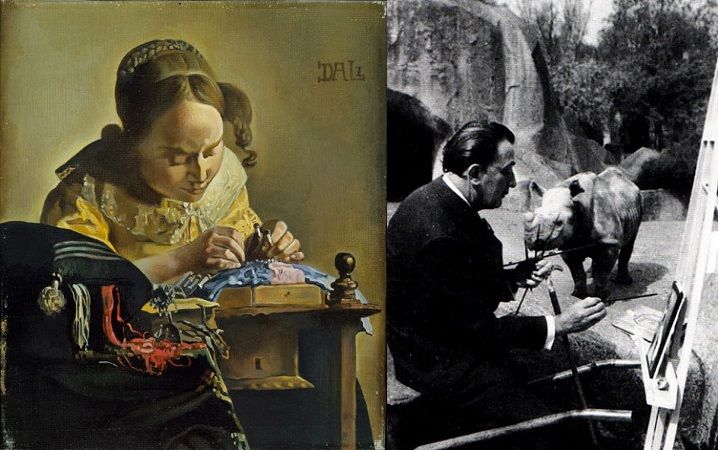
The Lacemaker (after Vermeer) and Dali in Vincennes Zoo
Dalí and the Rhinoceros — A Window into the Artist’s Eccentricity

In 1954, Salvador Dalí sat down in front of Vermeer’s painting The Lacemaker (1669–70) at the Louvre promising his audience of conservators and art historians that he would produce a copy of the masterpiece in one hour. Instead, Dalí emerged with a painting showing four intersecting rhinoceros horns. Apparently mystified by his own work, Dalí told his audience ‘The lacemaker is morphologically the horn of a rhinoceros.’1
Dalí claimed to have deconstructed The Lacemaker into rhinoceros horns by tracing the logarithmic spirals in the painting (that presumably appeared to his surrealist eye).
The Lacemaker is the most elaborate manifestation of Dalí’s rhinoceros obsession. In subsequent works, the rhinoceros horn is a symbol of chastity, strength and virility. In the Rhinocerotic Figure of Phidias's Illisos (1954), Dalí again reimagines a famous work with his own cosmic interpretation. The classical Greek torso fractures into rhinoceros horns above a weightless seascape, revealing its composition as it dissolves. In sculpture, Dalí’s bronze Cosmic Rhinoceros (1956) is a creature similar to its real-life counterpart, but with long spidery legs, balancing sea urchins on its back.
A year after the Louvre incident, Dalí perched on the edge of a wheelbarrow in the rhinoceros enclosure of Paris’s Vincennes Zoo to finish The Lacemaker (After Vermeer). As he began to paint, assistants lowered a large replica of The Lacemaker into the enclosure, tempting François the rhinoceros to charge the painting. François failed to indulge Dalí, who resorted to piercing the work himself with a Narwhal’s tusk.
The artistic merit of this episode is unclear. However, it provides an insight into the elaborate lengths to which Dalí would go in the name of art.
Dalí claimed to have deconstructed The Lacemaker into rhinoceros horns by tracing the logarithmic spirals in the painting (that presumably appeared to his surrealist eye).
The Lacemaker is the most elaborate manifestation of Dalí’s rhinoceros obsession. In subsequent works, the rhinoceros horn is a symbol of chastity, strength and virility. In the Rhinocerotic Figure of Phidias's Illisos (1954), Dalí again reimagines a famous work with his own cosmic interpretation. The classical Greek torso fractures into rhinoceros horns above a weightless seascape, revealing its composition as it dissolves. In sculpture, Dalí’s bronze Cosmic Rhinoceros (1956) is a creature similar to its real-life counterpart, but with long spidery legs, balancing sea urchins on its back.
A year after the Louvre incident, Dalí perched on the edge of a wheelbarrow in the rhinoceros enclosure of Paris’s Vincennes Zoo to finish The Lacemaker (After Vermeer). As he began to paint, assistants lowered a large replica of The Lacemaker into the enclosure, tempting François the rhinoceros to charge the painting. François failed to indulge Dalí, who resorted to piercing the work himself with a Narwhal’s tusk.
The artistic merit of this episode is unclear. However, it provides an insight into the elaborate lengths to which Dalí would go in the name of art.
Do you want to learn to write like this?
References
- Dalí, Salvador. Diary of a Genius. New York: Doubleday. 1965. 131