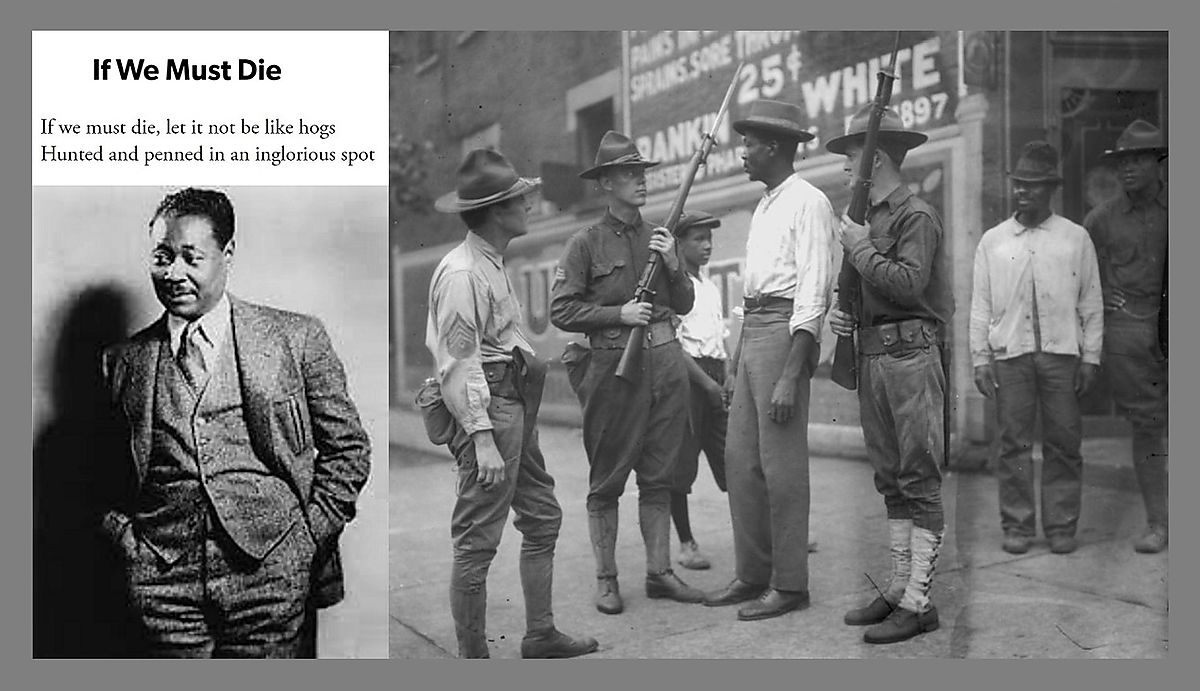
In the spring of 1919, the return of demobilised black soldiers from WWI sparked friction throughout cities across the United States. The simultaneous migration of black families to northern cities such as Chicago and a worsening economic climate1 led to further anxiety. Over the following months, in what became known as the ‘Red Summer’, the simmering tensions boiled over into riots. Blacks were ‘chased, dragged from street cars, beaten and killed within the shadow of the dome of the Capitol’2 by white mobs.
In the midst of the chaos was Claude McKay, a young Jamaican immigrant working as a waiter at the Pennsylvania Railroad. Upon hearing of the ‘murderous shooting and hangings’,3 the sonnet ‘If We Must Die’ is said to have ‘exploded’4 out of him.
Like men we’ll face the murderous, cowardly pack, Pressed to the wall, dying, but fighting back!”5
His fellow waiters were moved to the point of tears by McKay’s poem, but it was not until he sought to publish it that he realised its true power. Tempers ran high between the editors of the two competing magazines The Liberator and Pearson’s as they fought over the rights.6 The Liberator’s ‘high literary standard’,7 however, triumphed, with McKay thrilled to be appearing alongside esteemed writers in the July 1919 issue.
‘If We Must Die’ became the ‘inaugural address’ of the period.8 The poem was republished throughout the Red Summer and into the 1920s in an attempt to spark ‘black boldness’ for the ‘New Negro’ fighting his place,9 inspiring other artists to follow suit.
The movement became known as the Harlem Renaissance and McKay had unwittingly become its torch bearer.
‘If We Must Die’ was a significant turning point for the arts in 1920s America. Triggered by this poem, the once suppressed works of black writers and artists began to snowball into mainstream media in what became known as the Harlem Renaissance. When studying for my BA, I was inspired by this movement and its fresh manipulation of the English language.