
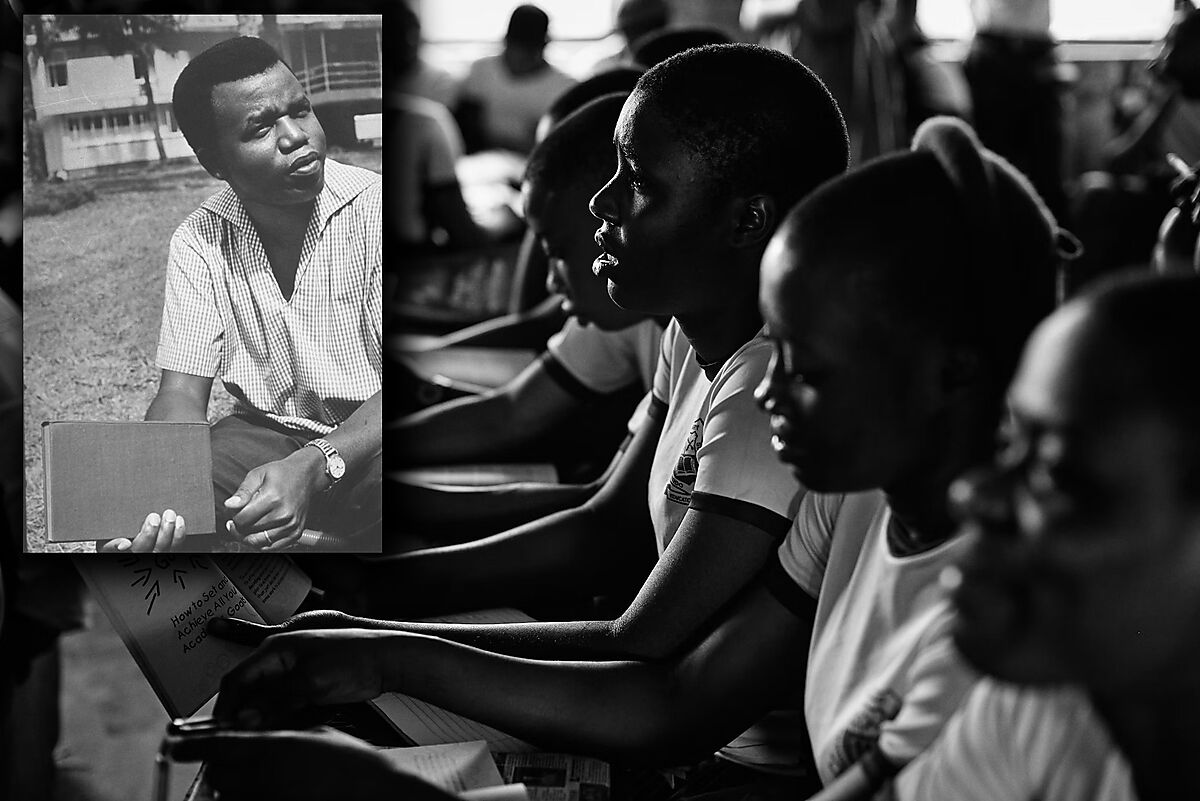
Oginigba Community Secondary School, Port Harcourt, Nigeria; Chinua Achebe, 1966 (Inset)
Chinua Achebe’s ‘Arrow of God’ (1964): An Insight into the Dynamics of Societal Collapse
In Chinua Achebe’s Arrow of God (1964), Ezeulu, the chief priest of Umuaro, summons the village elders to seek their support in a dispute with the British colonial officer, Captain Winterbottom. Winterbottom has ordered Ezeulu to report to him in a town six miles away, a distance the priest is not permitted to travel under traditional custom. The summons is also perceived as abrupt and inappropriate for a man of his stature. Yet when he lays the matter before the council, the elders decline to support him, leaving their priest — and by extension, their tradition — to face colonial authority alone.
Arrow of God is set in southeastern Nigeria, a region majorly inhabited by the Igbo (one of Nigeria’s three largest ethnic groups). British ambitions in the southeastern hinterland gained traction in 1891 when the Foreign Office authorised effective rule in the region.1 A decade later, the Aro Confederacy, the dominant political force in the area, was subdued by military force.2 However, efforts to establish control over the numerous smaller units were largely frustrated by their fragmented political organisation and decentralised power structures.3 In response, the British devised a system of appointing influential locals as warrant chiefs — individuals expected to represent colonial authority at the village level. The Native Courts Proclamation of 1901 formalised their status, naming them the sole native authorities within their communities.4
The Igbo were a deeply religious people, with rituals, oracles, and sacred traditions governing both private life and communal practices. When Christian missionaries arrived in the interior, they brought with them new systems of belief that often conflicted with indigenous practices. Churches and mission schools soon emerged as new centres of authority, gradually undermining traditional leadership. Some converts, especially those rising in colonial society, came to see Igbo customs as incompatible with Christian doctrine and sought to suppress them.5 The success of Christian missions ultimately led to an erosion of Igbo identity. By the time Achebe was born in 1930, Christianity had become a significant presence in southeastern Nigeria; his own parents had converted and adopted English first names.6
In Arrow of God, Achebe portrays Ezeulu as a strong-willed priest who believes his actions are divinely sanctioned and necessary for the spiritual well-being of the village. When a land dispute with a neighbouring clan arises, he testifies against Umuaro during Winterbottom’s arbitration, arguing that their claim lacks religious legitimacy. Later, he sends his son to the Christian mission — not as an act of betrayal, but as a calculated move to study the foreign faith from within. These decisions, although earning Winterbottom’s respect, deepen mistrust among the elders, who begin to question Ezeulu’s allegiance. As his friend warns, ‘Umuaro will always say that you betrayed them before the white man.’7
As colonial authority grows more assertive, the relationship between Ezeulu and the clan continues to deteriorate. When Winterbottom names him as a candidate for warrant chief, Ezeulu is disturbed by the summons and turns to the council for support. The elders dismiss his appeal, implying that he has brought the matter on himself. One rival retorts, ‘You passed the shit that is smelling; you should carry it away.’8 The exchange lays bare a leadership fractured by rivalry and devoid of collective resolve.
Ezeulu refuses the colonial appointment and is imprisoned, a moment that marks a turning point, one that he blames on the ‘defection of his people’9. On his return, he seeks to reclaim authority by insisting on strict adherence to ritual. As chief priest, he alone must eat twelve sacred yams, consuming the final one before the harvest may begin. His absence has disrupted the sequence, but he refuses to alter it. As the delay drags on, the yams begin to rot in the ground, and hardship descends on the village.
The crisis creates an opening for Christian missionaries, who offer a religious alternative: those who bring thank-offerings to the Christian God will be spared the wrath of Ulu. What had once seemed alien now appears plausible. Achebe writes that ‘there was no more laughter left in the people’.10 In desperation, families begin sending their children to church with offerings, seeking divine protection — and gradually, transferring their allegiance.11
What unfolds here reflects a larger truth: that societies collapse most readily when external pressures coincide with internal fragmentation. In Arrow of God Achebe shows that colonialism alone does not undo Umuaro; it is the erosion of communal bonds — mistrust among elders, personal rivalries, and Ezeulu’s increasing isolation — that prepares the ground. Achebe does not treat tradition as flawless, or colonial power as an absolute, overwhelming force. Instead, he shows how a society begins to fall apart when it can no longer hold together around a common moral and political core.
Achebe’s insight lies in showing that no system — traditional or modern — is immune to collapse when it ceases to serve its people. His vision resists nostalgia as much as it resists colonial triumphalism. This mirrors the internal strife in southeastern Nigeria that deepened under pressure from colonial officials and missionaries, hastening the demise of the local identity.
Arrow of God is the third in Achebe’s African Trilogy following Things Fall Apart (1958) and No Longer at Ease (1960). Across these works, he narrates the intersections of history, politics, and culture in Nigeria, earning widespread recognition — including the title ‘Father of African Literature’, which he modestly rejected. In 2007, he was awarded the Man Booker International Prize for his contribution to world literature. After a brief and disillusioning foray into politics, Achebe left Nigeria and spent his later years lecturing in the United States, where he remained until his death in 2013.
References
- Adiele E. Afigbo. The Warrant Chiefs: Indirect Rule in Southeastern Nigeria 1891–1929. London: Longman. 1972. p. 1
- John N. Oriji. Political Organisation in Nigeria since the Late Stone Age: A History of the Igbo People. New York: Palgrave Macmillan. 2011. p. 151
- John N. Oriji. Political Organisation in Nigeria since the Late Stone Age: A History of the Igbo People. New York: Palgrave Macmillan. 2011. p. 167
- John N. Oriji. Political Organisation in Nigeria since the Late Stone Age: A History of the Igbo People. New York: Palgrave Macmillan. 2011. p. 171
- Adiele E. Afigbo. The Warrant Chiefs: Indirect Rule in Southeastern Nigeria 1891–1929. London: Longman. 1972. p. 57
- Thomas Jay Lynn. Chinua Achebe and the Politics of Narration: Envisioning Language. London: Palgrave Macmillan. 2017. p. 12
- Chinua Achebe. Arrow of God. London: Penguin Classics. 2010. p.171
- Chinua Achebe. Arrow of God. London: Penguin Classics. 2010. p.188
- Chinua Achebe. Arrow of God. London: Penguin Classics. 2010. p.viii
- Chinua Achebe. Arrow of God. London: Penguin Classics. 2010. p.282
- Chinua Achebe. Arrow of God. London: Penguin Classics. 2010. p.300

When I first read Arrow of God, I was taken by its narrative quality: language, storyline, character portrayal, cultural detail. But I have always been fascinated by how societies govern themselves, how authority is distributed, and how it is transferred. That was why I decided to explore this theme in the novel. I was struck by how the underlying message in Achebe’s Umuaro echoed patterns I had encountered in the literature of other cultures across time and space.— Bede Ehiogu