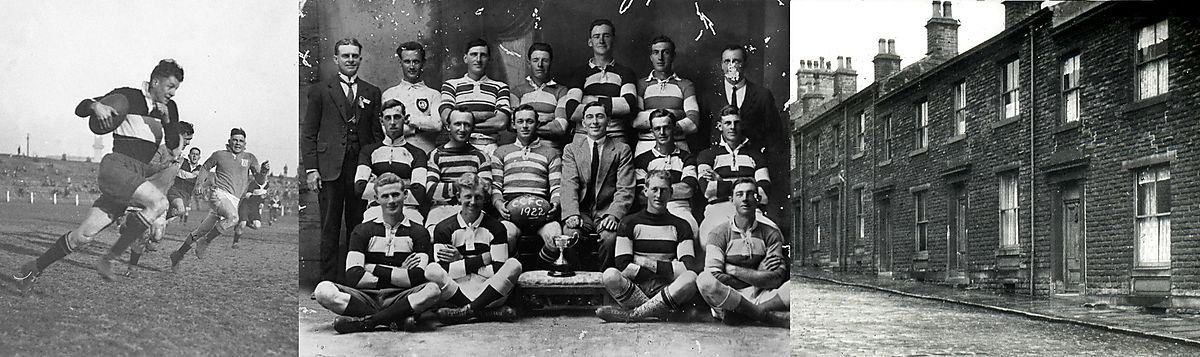
On 29 August 1895, representatives from 22 rugby clubs met at the George Hotel, Huddersfield, England to form the breakaway Northern Rugby Football Union. This followed disputes with the sport’s ruling body, the Rugby Football Union (RFU), over payments to players. The disagreement would define the two modern codes of rugby.
Fifty years earlier, in 1845, three schoolboys from Rugby School wrote the first rules of rugby, later standardised with the founding of the RFU in 1871. This association with private schools created a perception of the sport as elitist in the south.
In contrast, rugby was popular in many working-class northern counties, as players benefited from employment opportunities provided by factory owners keen to improve their local teams.1 2 Many northern towns, such as Bradford, Wakefield and Halifax, had formed as a result of industrialisation in the 1800s and gave rise to corresponding rugby teams.
However, for the poorer northerners, breaking off from work to play rugby meant lost wages, and many Yorkshire teams began to favour compensation. The RFU banned these “broken time” payments in 1886, an act arguably aimed at controlling the growing working-class influence within the sport.3
Payments continued despite a threat by the RFU in 1893 to charge teams found guilty of professionalism. Subsequently, the Northern Union was formed at the momentous George Hotel meeting. Rules were modified in 1897 and 1906 aimed at making rugby league more entertaining, with 13 instead of 15 players and the requirement to release the ball on being tackled.4
Today rugby league is almost exclusively played in the north of England; only four other professional teams play outside the region spanning Merseyside and east Yorkshire.
Having family in both Yorkshire and South Wales, I understand how important rugby is to many communities in Britain. Friends and acquaintances have painstakingly explained the pride of Rugby League in the north and Union in the south, bringing the “Great Split” to life.