
Bengal School of Art
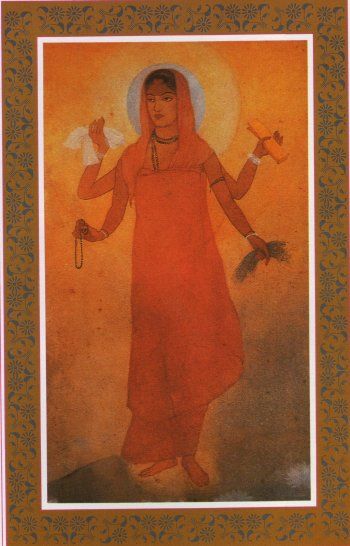
Bharat Mata
The Bengal School of Art was an art movement and a style of Indian painting that originated in Bengal, primarily Kolkata and Shantiniketan, and flourished throughout India during the British Raj in the early 20th century.
Also known as 'Indian style of painting' in its early days, it arose after British art teacher Ernest Binfield Havell attempted to reform the teaching methods at the Calcutta School of Art in 1896 by encouraging students to imitate Mughal miniatures. This caused controversy, as it was considered to be a retrogressive move.
Havell was supported by the artist Abanindranath Tagore, a nephew of the poet Rabindranath Tagore. Tagore painted a number of works influenced by Mughal art, a style that he and Havell believed to be expressive of India's distinct spiritual qualities, as opposed to the "materialism" of the West.
The Bengal school's influence in India declined with the spread of modernist ideas in the 1920s.
Also known as 'Indian style of painting' in its early days, it arose after British art teacher Ernest Binfield Havell attempted to reform the teaching methods at the Calcutta School of Art in 1896 by encouraging students to imitate Mughal miniatures. This caused controversy, as it was considered to be a retrogressive move.
Havell was supported by the artist Abanindranath Tagore, a nephew of the poet Rabindranath Tagore. Tagore painted a number of works influenced by Mughal art, a style that he and Havell believed to be expressive of India's distinct spiritual qualities, as opposed to the "materialism" of the West.
The Bengal school's influence in India declined with the spread of modernist ideas in the 1920s.
Bengal School of Art adapted from Wikipedia and licensed by The Cultural Me under CC BY SA 3.0