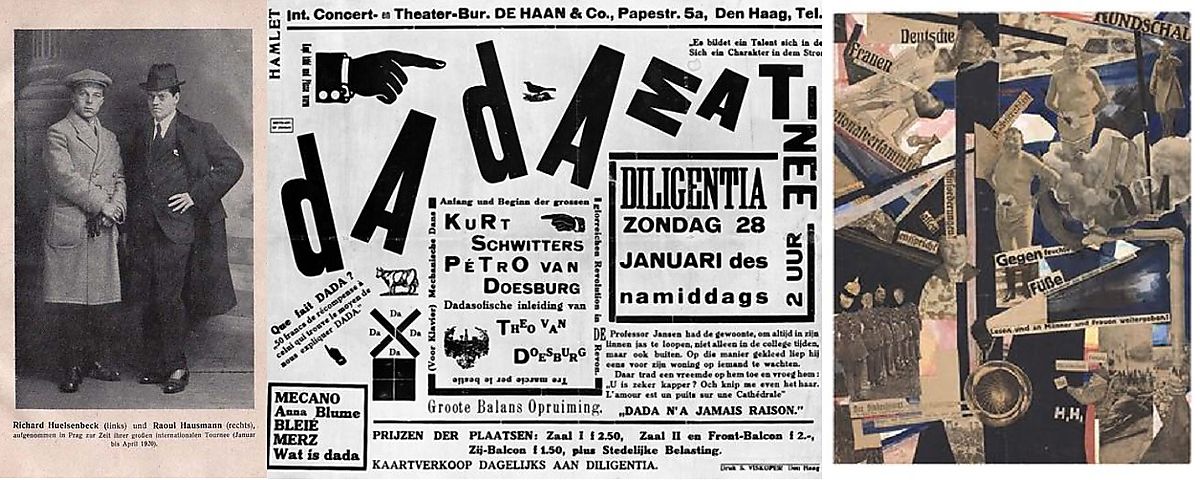
In January 1917, Richard Huelsenbeck, a 25-year-old writer, arrived in war-torn Berlin to spread word of a new art movement called dada. A year earlier, Huelsenbeck had helped found the movement at Cabaret Voltaire, a ‘little bar’1 in Zurich, Switzerland.
Dada was based on the philosophy of ‘art for art’s sake’. However, in Berlin, Huelsenbeck knew he would need ‘entirely different methods’2 to appeal to the people. Unlike neutral Zurich, Berlin had endured three years of war, and there was a revolutionary zeal in the air, stirred by hunger and poverty.
In Berlin, dada became activist, developing riskier political overtones and overtly critiquing society through its artforms.
Next year (1918), following Germany’s military defeat, the November Revolution ushered in the Weimar Republic. The revolution was seen as a beacon of hope amidst the prevailing social unrest. However, the dadaists remained sceptical of the new era. Fearing the old bourgeois values would continue to dominate,3 they sided with left-wing radicals, wanting to ‘destroy the moral, hypocritical bourgeois world.’4
The dadaists turned on (the prevailing) German expressionism, which they saw as a bourgeois art movement. They attacked its emphasis on emotional expression, arguing that this promoted ignorance of societal realities.
From the throes of their protest, a radical innovation was born: photomontages, created from Germany’s newly photo-illustrated press. Photomontages were innately modern and embodied the revolutionary spirit of the time, allowing for a more honest illustration of society. Hannah Hoch’s Dada Review (1919), which emasculates President Ebert with a strategically placed flower, is a notable example.
By the end of 1920, Huelsenbeck would declare, with remarkable accuracy, that ‘Dada is eternal and destined to achieve undying fame’5.
John Heartfeld and George Grosz; Anton Kaes, Martin Jay, Edward Dimendberg (eds). ‘The Art Scab (1920)’ The Weimar Republic Sourcebook. University of California Press. 1995. 484
Raoul Hausmann. Dada in Europa. Der Dada no.3 (Berlin, 1920) quoted in Hanne Bergius, “Dada Triumphs” Dada Berlin, 191702913, Artistry of Polarities, trans. Brigitte Pichon. New Haven. 2003
I first encountered the Berlin Dada movement in my final year at university studying 20th century German history. I was fascinated by how cultural movements contributed to Germany’s political discourse, specifically how the Berlin Dada movement simultaneously rejected and embraced Weimar modernity.