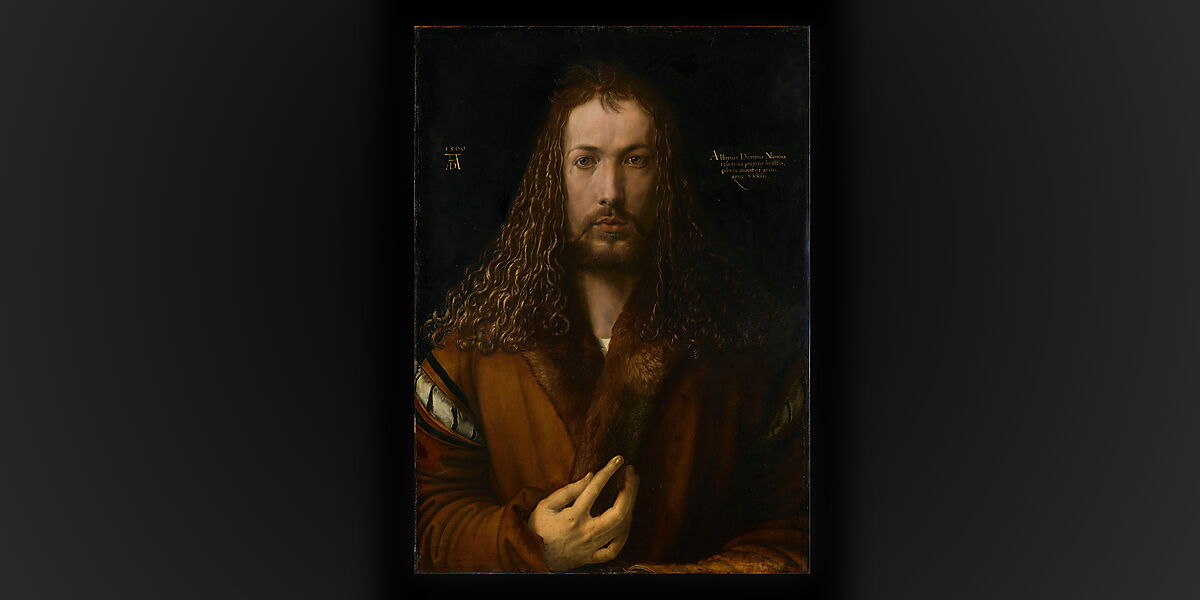
When Albrecht Dürer painted Self-Portrait with a Fur Collar (1500), he was not merely painting his true likeness but effecting a bold act of self-promotion. In Düer’s native Germany and northern Europe, since medieval times art was made largely anonymously by people viewed as craftsmen. But Dürer’s recent visit to Italy1 had opened his eyes to the potential. Artists there had personally developed reputations and were individually recognisable. Upon his return, Dürer may have wanted to achieve a similar status for himself in Germany.
Dürer styled Self-Portrait on Christian iconography,2 while subverting some of its conventions. The pose itself is confrontational and full-face, a perspective normally reserved for Christ, as secular subjects were typically painted in three-quarter view. The naturally red-headed Dürer also depicted himself with the brown hair of Christ, and his hand almost assumes the gesture of blessing. Instead of blessing the viewer, however, he strokes an expensive marten fur collar, as if to draw attention to the skill and status with which he had been blessed.
Dürer also removes all traces of context by presenting himself against a solid black background, instead of a conventional landscape. Positioning his initials as if to imply AD 1500, he writes the legend ‘I, Albrecht Dürer of Nuremberg portrayed myself in undying colours aged twenty-eight years’, a testament to his skill at the height of his powers.
The painting was probably shown to Dürer’s fellow humanists in Nuremberg and later hung in the city hall.3 It may well have functioned like an early modern business card: for clients who wanted an enduring legacy, as Dürer himself had achieved with his painting, they knew whom to commission.
Erwin Panofsky. The Life and Art of Albrecht Dürer. Princeton, N.J.: Princeton University Press. 2005. 8
Joseph Leo Koerner. The moment of self-portraiture in German Renaissance art. University of Chicago Press. 1993. 72
Joseph Leo Koerner. The moment of self-portraiture in German Renaissance art. University of Chicago Press. 1993. 70
Florence Gildea
London, UK
This was the first painting where, on seeing it, I felt like I was encountering the presence of another person, rather than just observing a work of art. Whenever I see it, I find the detail breathtaking — just look at the individual hairs of the fur collar as they stand out above his fingers — and the eyes completely hold my gaze.