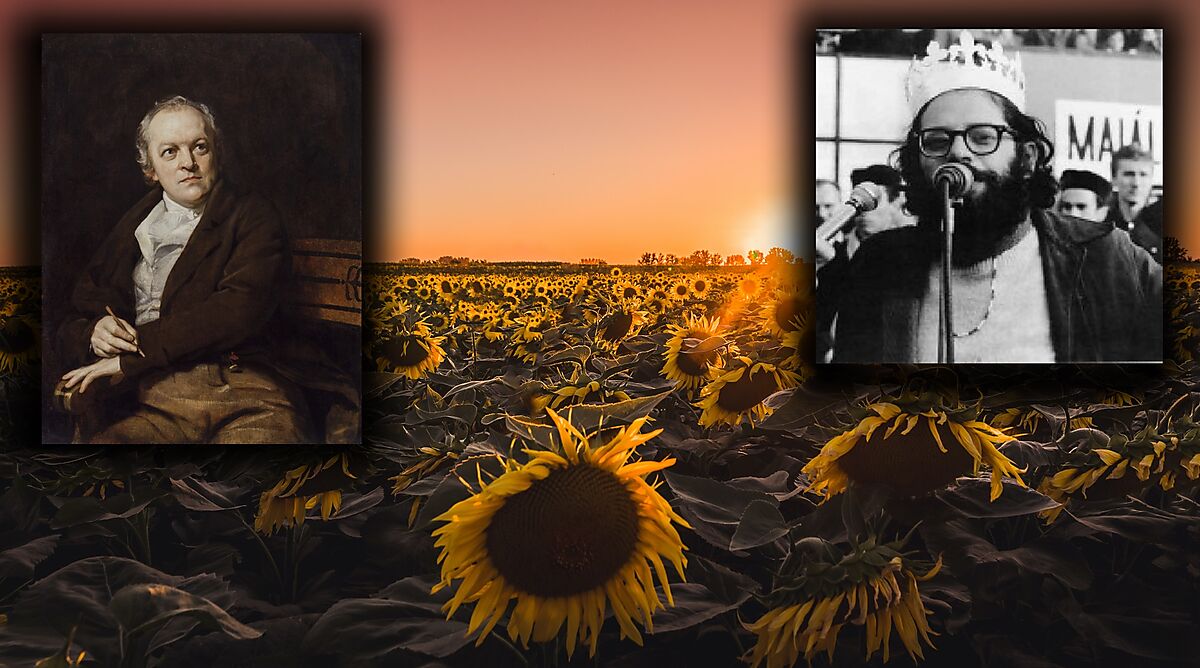
In a Harlem apartment in 1948, a 22-year-old Allen Ginsberg sat reading William Blake’s ‘Ah! Sunflower’ (1794), when a ‘deep earthen voice’ took over.1 Ginsberg knew the voice was Blake’s. In Blake’s deeply spiritual poem, the sunflower is a metaphor for the soul seeking the afterlife, and it seemed to Ginsberg that Blake was, in fact, talking about him.
A few years later, while whiling away time in a railway yard with his friend Jack Kerouac, Ginsberg encounters his sunflower again growing ‘on top of a pile of ancient sawdust’2. Ginsberg writes about this in ‘Sunflower Sutra’ (1955): ‘I rushed up enchanted— it was my first sunflower, memories of Blake—my visions—Harlem’3.
Ginsberg was a leading member of the Beat Generation, a movement of writers, musicians, and outsiders to mainstream America. Kerouac, a fellow ‘Beatnik’, described the Beats as ‘characters of special spirituality’ who lived ‘staring out of the dead wall window of our civilisation’.4 This is the Beatnik voice: harshly realistic pessimism.
In ‘Sunflower Sutra’, the murky industrial world of postwar America has corrupted Blake’s sunflower, leaving it ‘dusty with the smut and smog and smoke’5 in its eye. Ginsberg writes cynically about the ‘guts and innards’ of the city waste, the corpse-like decay into which it has fallen.
Yet Ginsberg also draws inspiration from this ‘perfect beauty’ of a sunflower’s resilience amidst the ‘skin of machinery’, since, in his Harlem vision, Blake had shown him that he too was a sunflower: ‘We’re not dread bleak dusty imageless locomotives, we’re golden sunflowers inside’6. For Ginsberg, the Beat Generation could thrive as outsiders: Blakean sunflowers in a grimy railway yard, hopeful nature infiltrating the city.
Allen Ginsberg. ‘A Blakean Experience’ in On the Poetry of Allen Ginsberg, ed. Lewis Hyde, pp. 120-31. Ann Arbor: University of Michigan Press. 1984. 122
Allen Ginsberg. ‘Sunflower Sutra’ in Howl, Kaddish, and Other Poems. London: Penguin. 2009. 19-21
Allen Ginsberg. ‘Sunflower Sutra’ in Howl, Kaddish, and Other Poems. London: Penguin. 2009. 19-21
J. Richard Gruber. American Icons: From Madison to Manhattan, the Art of Benny Andrews, 1948-1997. Georgia: Morris Museum of Art. 1997. 93
Allen Ginsberg. ‘Sunflower Sutra’ in Howl, Kaddish, and Other Poems. London: Penguin. 2009. 19-21
Allen Ginsberg. ‘Sunflower Sutra’ in Howl, Kaddish, and Other Poems. London: Penguin. 2009. 19-21
Elise Czyzowska
London, UK
Reading the poetry of Allen Ginsberg was one of the first things that inspired me to study literature at university. I spoke about ‘Howl’ during my interview, and used the Beat Generation in my final coursework. I love ‘Sunflower Sutra’ for how it intertwines Ginsberg’s poetry with his life. His Blakean vision is one of my favourite literary stories, because of how it adds such magical realism to our world.