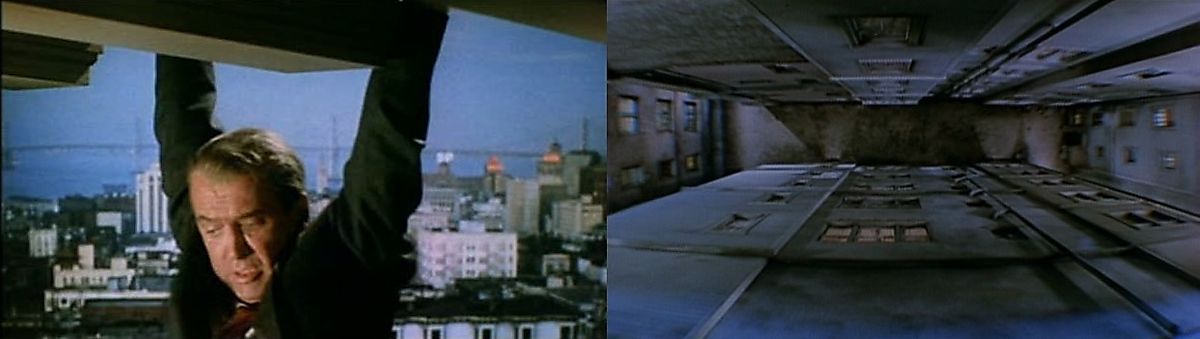
‘Walk the stairs, Judy,’ Scottie commands for the third time. As they climb up the tower, the camera suddenly switches to show the view from Scottie’s own eyes, as he faces the cavernous space below (2:03:18), drawing in the unsuspecting viewer through subjective camera.
In Alfred Hitchcock’s Vertigo (1958), John ‘Scottie’ Ferguson (James Stewart) is a former police detective suffering from acrophobia (a fear of heights) following a traumatic event during a chase. He is hired by his friend Gavin Elster (Tom Helmore) to investigate Elster’s wife’s strange behaviour, but all is not as it seems...
In the film, Hitchcock makes extensive use of subjective camera to position the audience as voyeurs. Unlike objective camera, where the camera could be positioned away from the action, in subjective camera it becomes the protagonist, conveying the character’s perception of events as they occur. In Scottie’s covert pursuits of Madeleine (Kim Novak) (19:13), (40:21), (53:34), by showing us his point of view as it unfolds, Hitchcock exploits the inherent human desire to watch whilst remaining unseen, and makes the viewer complicit in Scottie’s obsessive, voyeuristic behaviour.
Hitchcock also uses the subjective camera to develop the viewer’s empathy for Scottie’s acrophobia. He combines the point-of-view shot with the dolly-zoom (physically moving the camera in the opposite direction to the zoom) (2:03:18), (2:03:34) to artistically render Scottie’s feeling of disorientation and panic in the tower, creating the famous ‘Vertigo effect.’
In Vertigo, the subjective camera compels the viewer to adopt contrasting positions: as immoral voyeurs of Madeleine’s private life but also sympathetic to Scottie’s acrophobia. Hitchcock turns the viewer’s passive role into an active one—greater in responsibility and reward.
I first learned about the intricacies of cinematography while studying realist film at university. For me, it opened up a new way of viewing films, and to appreciate the care that goes into achieving the desired effects. This is one of the reasons I love Hitchcock’s films: I’m always struck by the degree of precision and attention to detail.