
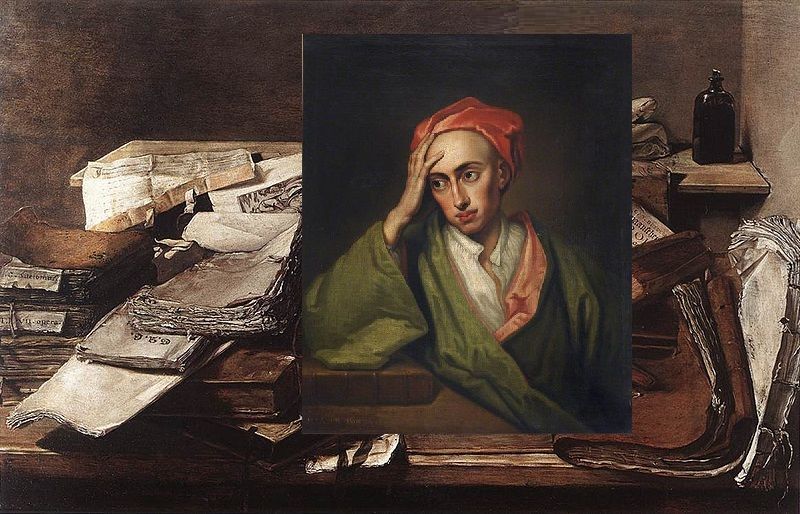
Alexander Pope and Still Life with Books
Alexander Pope: Grievous Disability and Inspired Writing

Alexander Pope was labelled as ‘the most notorious hunchback of the 18th century’ and a ‘hump-backed toad’ by those he satirised in his writings.1 His physical disabilities were not only a defining feature of his public persona but also inherently influenced both the style and content of his writing.
Pope suffered from Pott’s disease, leaving him with a curvature of the spine which stunted his growth at 4ft6in and rendered him a frail hunchback.2 He was also burdened with asthma, insomnia, headaches and an eye ailment.3
Pope rarely referred to his disabilities in his writing. In The Club of Little Men (1713), he describes the ridiculous rituals of a group of short men, providing a self-mocking and humorous insight into being of small stature.4 In another work, his Epistle to Dr Arbuthnot (1735), he briefly details his flaws, writing ‘I cough like Horace, and tho lean, am short’.5
Pope’s experience of living with his disability was probably the source of his sharp wit and provocative criticism, exemplified in his mock-epic The Dunciad (1713).6 Pope uses the poem to attack contemporary figures who criticised his work, such as the poet laureate Colley Cibber. He crowns Cibber as the King of Dunces, and accuses him of having ‘less human genius than God gives an ape’.7
During the turbulent 18th century, disability was ‘something over which the individual sufferer triumphs’.9 Pope did not triumph over his disability, but rather lived alongside it, drawing inspiration for his writing successes.
Pope suffered from Pott’s disease, leaving him with a curvature of the spine which stunted his growth at 4ft6in and rendered him a frail hunchback.2 He was also burdened with asthma, insomnia, headaches and an eye ailment.3
Pope rarely referred to his disabilities in his writing. In The Club of Little Men (1713), he describes the ridiculous rituals of a group of short men, providing a self-mocking and humorous insight into being of small stature.4 In another work, his Epistle to Dr Arbuthnot (1735), he briefly details his flaws, writing ‘I cough like Horace, and tho lean, am short’.5
Pope’s experience of living with his disability was probably the source of his sharp wit and provocative criticism, exemplified in his mock-epic The Dunciad (1713).6 Pope uses the poem to attack contemporary figures who criticised his work, such as the poet laureate Colley Cibber. He crowns Cibber as the King of Dunces, and accuses him of having ‘less human genius than God gives an ape’.7
During the turbulent 18th century, disability was ‘something over which the individual sufferer triumphs’.9 Pope did not triumph over his disability, but rather lived alongside it, drawing inspiration for his writing successes.
Do you want to learn to write like this?
References
- Roger Lund. Laughing at Cripples: Ridicule, Deformity and the Argument from Design. Eighteenth-Century Studies, 39.1, 91-114. 2005. 92
- Helen Deutsch. Resemblance & Disgrace: Alexander Pope and the Deformation of Culture. Cambridge: Harvard University Press. 1996. 1
- E. M. Papper. The influence of chronic illness upon the writings of Alexander Pope. ournal of the Royal Society of Medicine, 82 (1989), 359-361. 1989. 359
- E. M. Papper. The influence of chronic illness upon the writings of Alexander Pope. ournal of the Royal Society of Medicine, 82 (1989), 359-361. 1989. 360
- Alexander Pope, Pat Rogers (Ed.). An Epistle to Dr Arbuthnot’ in Alexander Pope The Major Works. New York: Oxford University Press Inc.. 1993. 340
- E. M. Papper. The influence of chronic illness upon the writings of Alexander Pope. ournal of the Royal Society of Medicine, 82 (1989), 359-361. 1989. 361
- Alexander Pope, Pat Rogers (Ed.). 'The Dunciad' in Alexander Pope The Major Works. New York: Oxford University Press Inc. 1993. 456
- Alexander Pope, Pat Rogers (Ed.). 'The Dunciad' in Alexander Pope The Major Works. New York: Oxford University Press Inc. 1993. 460
- Lennard David, Helen Deutsch (Ed.). ‘Dr Johnson, Amelia and the Discourse of Disability in the Eighteenth Century’ in Defects: Engendering the Modern Body. Michigan: University of Michigan Press. 2000. 62