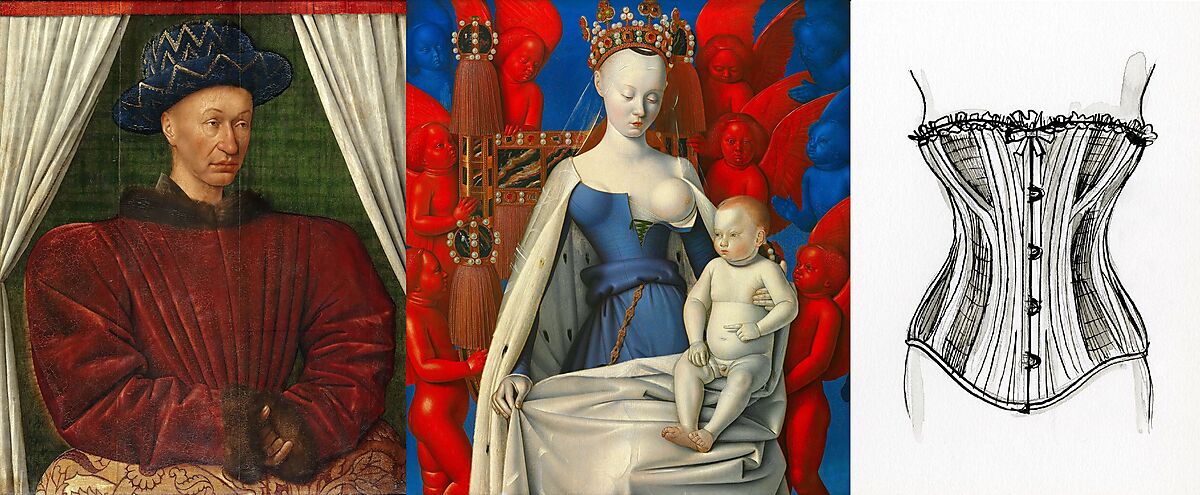
In 1444, the ‘extraordinarily beautiful’1 Agnes Sorel was only 22 when the 40-year-old French king Charles VII chose her to be his mistress. At the time, Sorel, from a family of lesser nobility, was lady-in-waiting for the Queen, Marie d’Anjou.
Charles had been crowned king of France in 1429 when, aided by the spiritual leadership of the peasant girl Joan of Arc, he managed to drive back English and Burgundian troops in the Hundred Years’ War.
Charles legitimised his relationship with Sorel by publicly acknowledging her as his mistress,2 a role that would develop into a semi-official position in later French monarchies. He gave her great wealth and gifts, including Beauté-sur-Marne, a castle near Vincennes,3 as a result of which Sorel became known as Dame de Beauté, literally ‘Lady of Beauty’. Sorel bore Charles four daughters; She died in 1450 aged 28, soon after the birth of her fourth child.
Sorel influenced the fashions of the ladies of the French court4 and commoners alike5. She is said to have worn her bodice unlaced, through which her breasts were said to be visible, a fact commented upon by the French cleric and historian Jean Juvénal des Ursins (1388–1473).6
By the mid-19th century, no doubt aided by Jean Fouquet’s painting Virgin and Child (1452), Sorel’s décolletage had developed a new reputation — one of toplessness. The painting, which shows the madonna with one breast exposed, was painted two years after Sorel’s death and is said to resemble her.7 However, there is no evidence to suggest that Sorel publicly exposed her breasts in court at any time.
Her myth, however, gave birth to two fashion items, the Agnes Sorel Bodice, which is full-sleeved with a square-cut neckline, and the Agnes Sorel Corsage — the latter a waistcoat style which can be worn exposing the breasts.8
Kathleen Wellman. Queens and Mistresses of Renaissance France. Yale: Yale University Press. 2013. 25
Sanche de Gramont and Ted Morgan. Epitaph for Kings. New York: Putnam. 1968. 112
Linda Kiernan. Absolutely Beautiful? Madame de Pompadour and the Aesthetics of Power. In: Female Beauty Systems: Beauty as Social Capital in Western Europe and the United States. Newcastle: Cambridge Scholars Publishing. 2015. 189
Valerie Steele. Paris Fashion: A Cultural History. London: Bloomsbury Publishing. 2017. 27
Lori Hope Lefkovitz. Textual Bodies: Changing Boundaries of Literary Representation. New York: SUNY Press. 1997. 116
Sheila Delany. Impolitic Bodies: Poetry, Saints, and Society in Fifteenth-century England: The Work of Osbern Bokenham. Oxford: Oxford University Press. 1998. 108
Christa Grossinger. Picturing Women in Late Medieval and Renaissance Art. Manchester: Manchester University Press. 1997. 59
Valerie Cumming, C. W. Cunnington, P. E. Cunnington. The Dictionary of Fashion History. Oxford: Berg. 2010. 2
Jessica Naden Batten
London, UK
I find the claim that women of the historical past were more modest than the women of today and that dressing in a provocative fashion wasn’t the done thing rather strange; particularly how this argument is used against women on the internet. I like how the provocative style of dresses in the 1700s was enjoyed equally by court ladies and common women alike.