

Girl, Flower
Agnes Martin, ‘The Islands’ (1961), and the Depiction of Perfection
Imagine a perfect moment. A warm mug of tea in your hands on a cold morning. Could this moment be represented in art? The works of Canadian artist Agnes Martin are about perfection — as ‘we are aware of it in our minds’1.
In 1957, at the age of 45, Martin moved to New York City, where she became associated with the abstract expressionist art movement. She painted The Islands in 1961, a grid of small white dots on a sandy canvas. Martin left many of her works untitled, and while it is tempting to speculate these tiny grains are indeed islands, this goes against the idea of pure abstraction versus representation — Martin is not trying to represent anything here, rather she is trying to capture something else: the feeling of perfection.
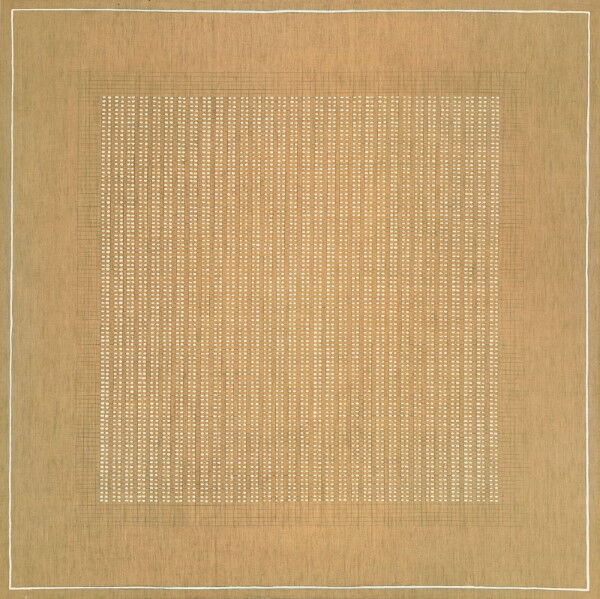
At first glance, it is a geometrically perfect grid, but stare long enough and things start to seem ‘off’. The white border is not exact, the dots all different sizes, and the lines prominent in some places and faint in others. Yet these imperfections have not been deliberately introduced, rather they are the inevitable result of painting by hand.
Martin says that her works are ‘very far from being perfect’.2 What matters to Martin is not creating or representing perfection. Much like trying to capture the feeling of warmth from a mug of tea, she knows this is impossible. For her, a work of art only needs a ‘hint of perfection’ to be successful, to come alive.3 We do not need to see perfection in art because we already know what it is.
To illustrate this idea, Agnes Martin once held out a rose to a little girl and asked her if it was beautiful, to which the girl replied yes. Martin then concealed the flower and asked whether it was still beautiful. She received the same answer.4 Perfection is not something that exists in an object. It is an idea, an awareness, a memory, that already lives in our minds.
References
- Dieter Schwarz (ed.). Agnes Martin: Writings. Berlin: Hatje Cantz. 1997. p. 15
- Dieter Schwarz (ed.). Agnes Martin: Writings. Berlin: Hatje Cantz. 1997. p. 15
- Dieter Schwarz (ed.). Agnes Martin: Writings. Berlin: Hatje Cantz. 1997. p. 32
- Arne Glimcher. Agnes Martin: Painting, Writings, Remembrances. London: Phaidon Press. 2012. p. 13

The first time I encountered Martin’s art, I remember feeling two things. First, utter confusion - how could this, a collection of lines and squares, count as art? But then the more I looked, the more a strange calmness washed over me. Her work does so much with so little, acting as a welcome break from the hectic world around us.— Dennis Sun