
The Origins of Museums
Accumulating a Microcosm of the World: Renaissance Cabinets of Curiosities and the Origins of Museums

In 1638, the German traveller Georg Stirn recorded his visit to the home of Englishman John Tradescant in South Lambeth, London. Tradescant gave his guest a tour of his “Cabinet of Curiosities” (cabinet being used in the archaic sense of a small private room), where Stirn was shown (among other things) a piece of wood from the cross of Christ, the robe of the King of Virginia, and the hand of a mermaid.1
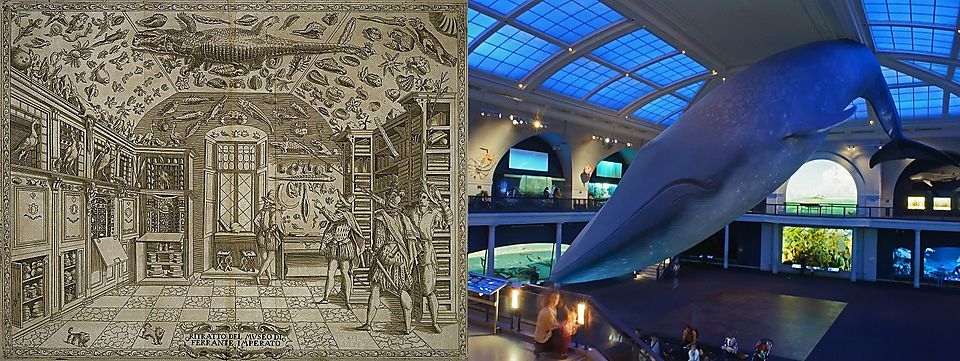
The cabinets of curiosities of Renaissance Europe were the precursors to modern museums. Their scope was encyclopaedic, at a time when the aim of collecting the whole of nature into a microcosm seemed achievable. It was a way to have the world in one’s pocket: the finest Italian tapestries draped above animal skulls, scientific instruments of cartography alongside vials of powdered unicorn horn.
These early collections, unlike today’s museums, had organisational principles based on Renaissance philosophy rather than scientific classification. Tradescant sought “any thing that Is strange”,2 which was then divided broadly into “Natural” and “Artificial”. The Grand Duke of Tuscany Francesco I de’ Medici, by comparison, kept his collection of miscellaneous riches in a secret chamber next to his bedroom, organised by the elements, so that the collector, when stood in the middle, was at the centre of their own universe,3 illustrating the Renaissance impulse to accumulate and place oneself within a microcosm of the world.
As for Tradescant's collection, it formed the nucleus of Oxford University's Ashmolean Museum: the world's first purpose-built public museum.
The cabinets of curiosities of Renaissance Europe were the precursors to modern museums. Their scope was encyclopaedic, at a time when the aim of collecting the whole of nature into a microcosm seemed achievable. It was a way to have the world in one’s pocket: the finest Italian tapestries draped above animal skulls, scientific instruments of cartography alongside vials of powdered unicorn horn.
These early collections, unlike today’s museums, had organisational principles based on Renaissance philosophy rather than scientific classification. Tradescant sought “any thing that Is strange”,2 which was then divided broadly into “Natural” and “Artificial”. The Grand Duke of Tuscany Francesco I de’ Medici, by comparison, kept his collection of miscellaneous riches in a secret chamber next to his bedroom, organised by the elements, so that the collector, when stood in the middle, was at the centre of their own universe,3 illustrating the Renaissance impulse to accumulate and place oneself within a microcosm of the world.
As for Tradescant's collection, it formed the nucleus of Oxford University's Ashmolean Museum: the world's first purpose-built public museum.
Do you want to learn to write like this?
References
- Georg Christoph Stirn (Brent Nelson Ed.). Travel Diary of Georg Christoph Stirn of Nürnberg
- Tigner, A. L.. 'The Tradescants' Culinary Treasurers' 12:4. Gastronomica: The Journal of Critical Food Studies.. 2012. 81
- O. Impey, A. Macgregor (Eds). The Origins of Museums The Cabinet of Curiosities in sixteenth- and seventeenth-century Europe. Clarendon Press, Oxford. 1985