
Abstract Expressionism vs Pop Art

Abstract Expressionims vs Pop Art
Abstract expressionism was an art movement that emerged in post-WW2 New York (late 1940s). Abstract expressionism is non-representational art, in other words, the works do not attempt to depict real-world objects; instead the artist evokes a response from the viewer through the use of abstract patterns and colour.
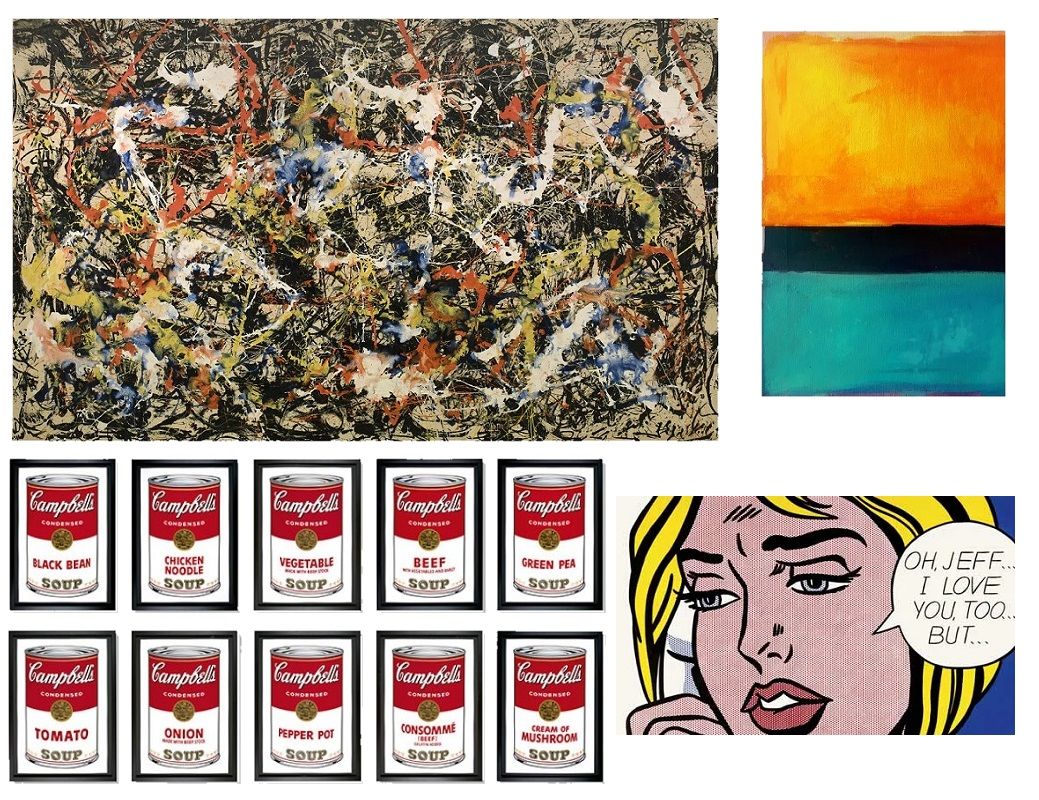
As an example, one of the principal proponents of the genre Jackson Pollock created art by dripped paint across his large canvases, sometimes suspending himself by wire, to create random patterns. Mark Rothko, another major figure, painted subtle rectangles of colour onto a base layer, creating the illusion of floating bands of colour.
The art of Pollock and Rothko is expressionist because the works surface a deeply personal emotional account of the human condition through the dynamism and sensuousness of the composition.
Pop art, on the other hand, originated in London in the 1950s but it was in the United States that it took root and flourished. There, in turning its back on non-representational art, it found a voice as a contrasting alternative to abstract expressionism.
The subjects of pop art were the everyday objects of consumer or popular culture; one of the movement’s well-known figures Andy Warhol’s exact reproduction of cans of soup is a prominent example. Another leading artist Roy Lichtenstein created art from comic strips.
Pop art was in some ways a protest against the perceived elitism of abstract expressionism, which, with its detachment from reality, was seen as inaccessible to the average person. The objects depicted in pop art, in contrast, were firmly rooted in the real world, enabling the viewer to relate to their time.
As an example, one of the principal proponents of the genre Jackson Pollock created art by dripped paint across his large canvases, sometimes suspending himself by wire, to create random patterns. Mark Rothko, another major figure, painted subtle rectangles of colour onto a base layer, creating the illusion of floating bands of colour.
The art of Pollock and Rothko is expressionist because the works surface a deeply personal emotional account of the human condition through the dynamism and sensuousness of the composition.
Pop art, on the other hand, originated in London in the 1950s but it was in the United States that it took root and flourished. There, in turning its back on non-representational art, it found a voice as a contrasting alternative to abstract expressionism.
The subjects of pop art were the everyday objects of consumer or popular culture; one of the movement’s well-known figures Andy Warhol’s exact reproduction of cans of soup is a prominent example. Another leading artist Roy Lichtenstein created art from comic strips.
Pop art was in some ways a protest against the perceived elitism of abstract expressionism, which, with its detachment from reality, was seen as inaccessible to the average person. The objects depicted in pop art, in contrast, were firmly rooted in the real world, enabling the viewer to relate to their time.