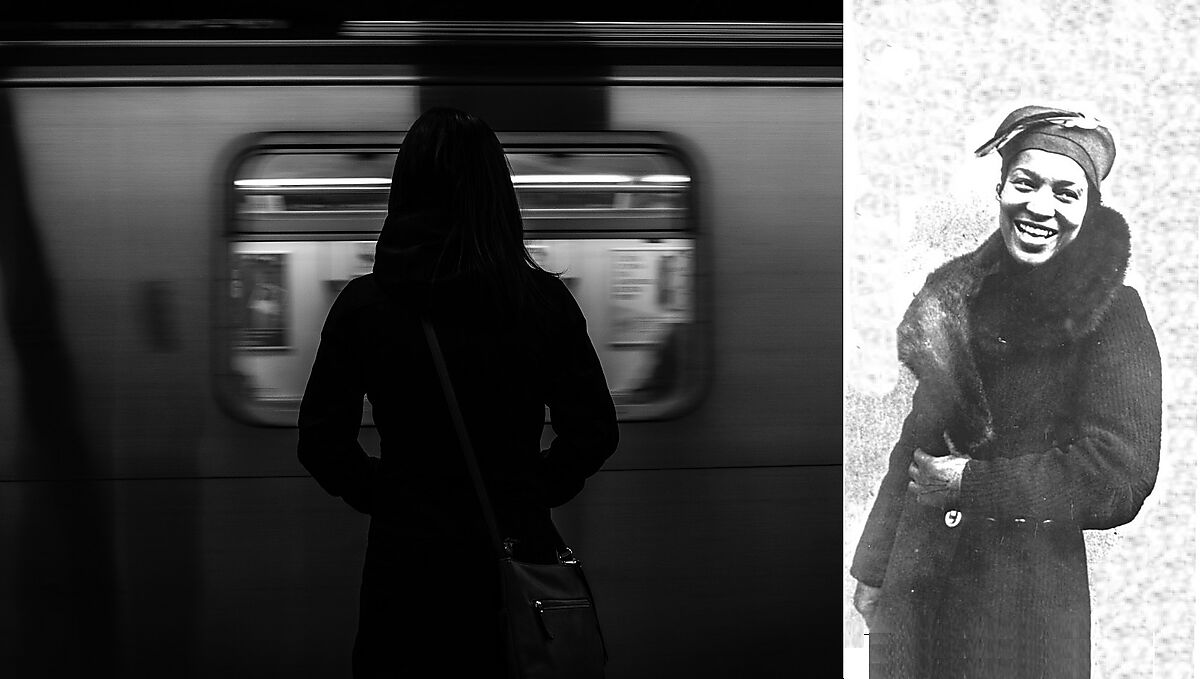
Zora Neale Hurston, at 36 a mature student at Columbia University, boarded a train from New York to her hometown, the all-black township of Eatonville, Florida, in February 1927.1 In New York, Hurston was part of the literary and artistic flourishing that was the Harlem Renaissance. She was Florida-bound merely to gather folklore for her BA Anthropology, but under the Harlem influence her research would be repurposed to form the novel Their Eyes Were Watching God (1937).
In the novel, the reader follows the female protagonist, Janie Crawford, in her pursuit of personal identity. Despite seeking ‘life without being a man’s mule’,2 Janie becomes trapped in two unhappy marriages, enduring a torrent of physical violence behind closed doors. One day, resplendent in a new blue dress,3 Janie leaves Eatonville and enters into an erotic third marriage with the vagrant Tea Cake, who introduces her to African-American expressive culture.4 From working close together in the Everglades fields, to preparing supper, will Janie finally find herself through her love for a man?
Their Eyes was poorly received. The use of phonetic dialect was said to mock the English used amongst black communities5 — a ‘minstrel technique’ that made ‘the ‘white folks’ laugh’.6 Hurston’s sexually explicit descriptions were also frowned upon — especially coming from a woman’s perspective. Hurston, however, wanted her characters to live a ‘swarming, passionate life’,7 going against the grain of the then New Negroes, who in their pursuit of racial equality, wanted to quash the perception of black promiscuity.
In the end, Hurston’s train journey to Eatonville would not be in vain: Their Eyes is now considered a classic of the Harlem Renaissance.8
Cheryl A. Wall. ‘Zora Neale Hurston: Their Eyes Were Watching God’, in A Companion to Modernist Literature and Culture. Blackwell Publishing Ltd. 2006. 376–383
Zora Neale Hurston. Their Eyes Were Watching God. JP. Lippincott & Co. 1937. 116
Cheryl A. Wall. ‘Zora Neale Hurston: Their Eyes Were Watching God’, in A Companion to Modernist Literature and Culture. Blackwell Publishing Ltd. 2006. 376–383
Literary norms were broken when Zora Neale Hurston decided to write a novel from the perspective of a black woman. At a time when her male counterparts — namely Hughes and McKay — gained momentum with their works, much of Hurston’s contributions during the Harlem Renaissance were ignored. An inspiration to women from its point of publication, then, I felt the need to celebrate Hurston’s work.