
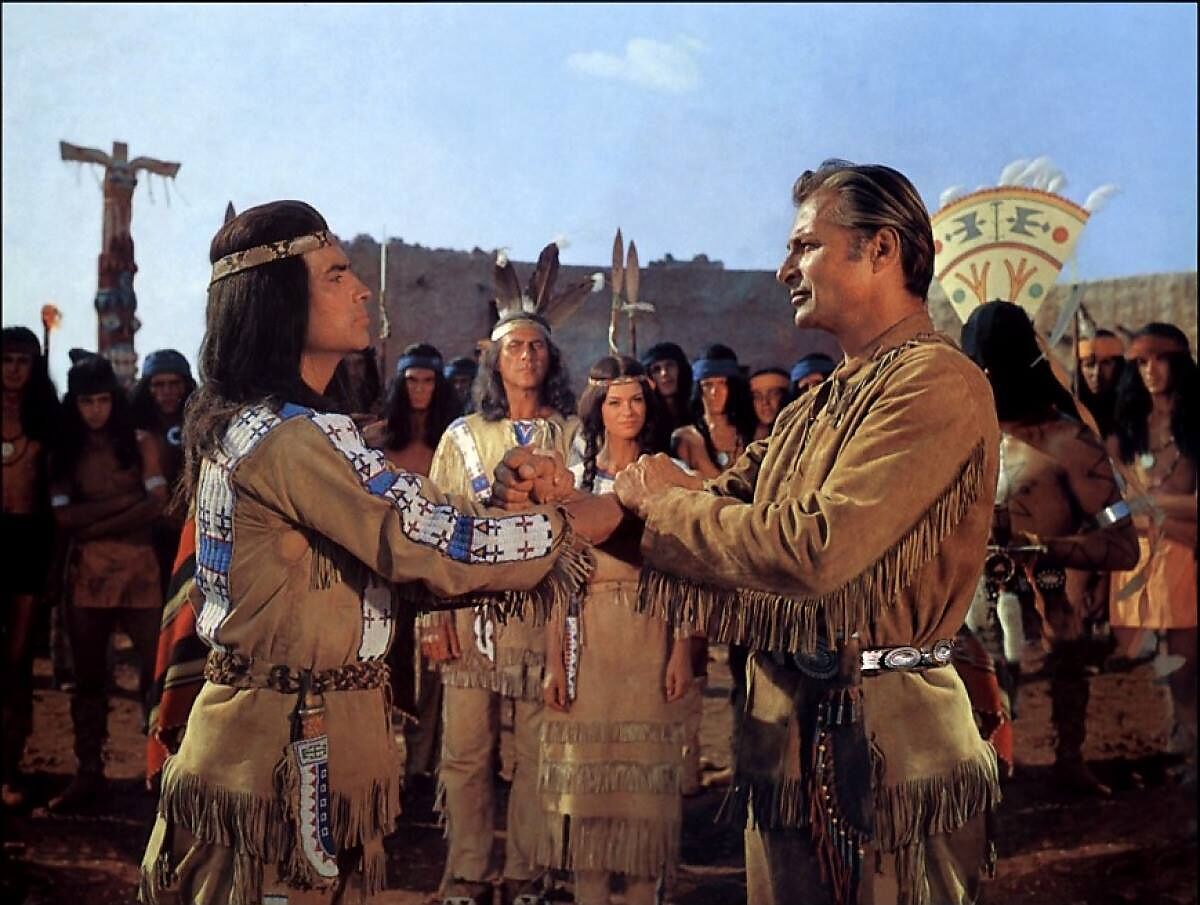
Still from ‘Winnetou the Warrior’ (1963)
The Noble Savage in Karl May’s ‘Winnetou Series’ (1893–1910) and James Fenimore Cooper’s ‘Leatherstocking Tales’ (1823–1841)
In 1893, the German reading public was introduced to the fictional adventures of a young German named Karl, who sets out to work on the burgeoning railroad system in America, and his deep friendship with his ‘blood-brother’ Winnetou, the son of an Apache chief. Throughout the 15 novels which make up the Winnetou Series (1893–1910), author Karl May casts himself in the thinly veiled guise of protagonist Karl, who later becomes known as Old Shatterhand, a name referencing his characteristically powerful punch. However, May would only travel to America in 1908, many years after the publication of the first stories.1 Instead, he would rely on the accounts of others and his imagination to send Karl and Winnetou on their adventures.
One of May’s primary influences was very likely James Fenimore Cooper and his five-book series Leatherstocking Tales (1823–1841) published 70 years earlier. Cooper’s stories are set in the former Iroquois area around New York in the 18th century and relate the adventures of Natty Bumppo, a white Euro-American frontiersman most commonly known as ‘Leatherstocking’, and his companion Chingachgook, a Mohican chief.
These stories proved popular with a European and North American public that had witnessed large-scale industrialisation and urbanisation due to technological progress. The shift from a rural, self-sufficient farming community to an urban one, one that was dependent on a market economy to provide food and shelter, had begun in the Middle Ages in Europe and intensified over the ensuing centuries. Native Americans, on the other hand, had retained their self-sustaining economies when Europeans arrived in the 17th century. It was on this idyll of the prairies on which Cooper’s Leatherstocking Tales was set, evoking the idea of a lost paradise for a readership in the grip of industrialisation.
In May’s Winnetou Series, the first encounter between Karl and Winnetou occurs when a railroad workers’ campsite, in which Karl finds himself, is visited by the Apache chief Intschu Tschuna, accompanied by his son Winnetou and their German-born advisor Klekih Petra. The warriors try to dissuade the workers from constructing a railroad through Apache territory, but tensions escalate when the workers refuse to comply. Despite working for the railroad, and driven by a sense of justice, Karl secretly joins forces with the Apache to hinder the plans of his employer. As the story progresses, Karl, who is now known as Old Shatterhand, becomes entangled in the complex dynamics of the American frontier, in a landscape where other tribes such as the Kiowa also pose a threat. He forms a unique bond with Winnetou, and in a ritual involving drawing blood, they become blood-brothers (a practice that, despite May’s claims, was not a part of Apache culture2).
In the series, the Apache semi-nomadic lifestyle and oneness with nature is highlighted and elaborated upon; in one episode the frontiersmen are bewildered when they discover that no part of a slayed bear is wasted, with parts that are not eaten being used as base material for garments and equipment. While such practices were seen as uncivilised by Europeans and their descendants who, having lived in cities, had become reliant on systems of production, there was much to be envied of the Apache self-sustaining reliance on nature, something that had become less and less common in Europe and was dwindling in North America too.
May also portrays Christianity as the correct, even noble, religion with the gradual inclusion of Christian beliefs into Winnetou’s worldview. Ultimately, on his deathbed, he exclaims ‘Schar-Iih, ich glaube an den Heiland. Winnetou ist ein Christ. Lebe wohl!’ (I believe in the saviour. Winnetou is a Christian. Farewell!)3
‘Savage’ acts, seeming unfamiliar to the European frontiersmens, such as scalping, play a central part in May’s novels. In the works of Cooper (whose work influenced May), it is suggested that the act of scalping if carried out by a European would be immoral; however, the same act would be acceptable if undertaken by a Native American.4 Cooper’s Natty Bumppo describes Chingachgook as an honourable man, going as far as to compare him to a Roman Emperor, showing the ideal to which he upholds him. Bumppo and he subscribe to the same righteous codes, according to their communities’ respective norms.
Thus both authors employ the trope of the ‘Noble Savage’ in their portrayal of Native Americans. Viewed through a European lens the Native American is savage yet loyal, whose morals remained untouched by Western norms — implicitly suggesting the progressiveness of the latter. For Cooper, for instance, Europeans belonged to a morally superior civilisation for whose members it would be wrong to partake in savagery such as scalping, yet the same act would be acceptable for a lesser people.
The Noble Savage trope was not an invention of Cooper’s; the trope was present in European intellectual thought as early as the Roman Empire where it was employed to describe the Germanic tribes of middle Europe. The Roman historian Tacitus (56CE–c120) in his Germania (c 98CE) describes the virtues of the Germanic tribes, their bravery in battle and code of honesty, and yet portrays them as a comparatively primitive people.5 (Tacitus too may have relied on second-hand accounts as there is no evidence that he ever travelled to Germania.)
From the 16th century onwards, with the onset of European migration to North America, a similar romanticised depiction of Native Americans emerged in European art and literature. The Native American within this trope is a calm, pacifist individual who is at one with nature (and the spiritual realm), who often only breaks his silence to share words of wisdom. With these broad brushstrokes, the complexities and individuality of Native American culture are painted over, leaving behind a reductive and misleading image.
More recently the German film Der Junge Häuptling Winnetou (The Young Chief Winnetou; 2022) traces a hypothetical narrative where Winnetou and Old Shatterhand meet in their childhood. Here too, we see echoes of the historical image resurfacing, perpetuating a pernicious myth of the Native American, showing that little has changed.
References
- Karl May. "Karl May – Fantast, Bestseller-Autor und Visionär Biografie & Werk". Karl May Museum. 2024
- Geolino. "Karl May: Karl Mays Indianervokabeln und ihre tatsächliche Bedeutung". Geolino. 2013
- Karl May. Winnetou. Band 3. Berlin: Verlag Neues Leben. 1983. p.401
- Ceisy Nita Wuntu. "James Fenimore Cooper and the idea of environmental conservation in the Leatherstocking Tales (1823-1841)". Rubikon Journal of Transnational American Studies. 1, no. 2. 2014. 25-38. p. 27
- Frank Usbeck. "Kampf der Kulturen?,Edle Wilde' in Deutschland und Amerika". in Iris Edenheiser Astrid Nielsen (ed.). Tecumseh, Keokuk, Black Hawk: Indianerbildnisse in Zeiten von Verträgen und Vertreibung ; Sonderausstellung der Staatlichen Ethnographischen Sammlungen Sachsen im Albertinum Dresden, 1. Oktober 2013 bis 2. März 2014. Dresden: Staatliche Kunstsammlungen Dresden, 2013; Stuttgart: Arnoldsche Art Publishers. 2013. pp. 177-183. p. 178

I grew up a mere half hour from where Karl May’s stories about Winnetou were penned and published, and so they were an integral part of my youth. Later, when I started formal study of the tropes in James Fenimore Cooper’s The Leatherstocking Tales, it made me wonder whether the books I had read in my childhood were also influenced by that idolisation. This was the beginning of a critical reevaluation of the truth of the world suggested by my childhood storybooks and the protagonists within.— Elisabeth Leibnitz