
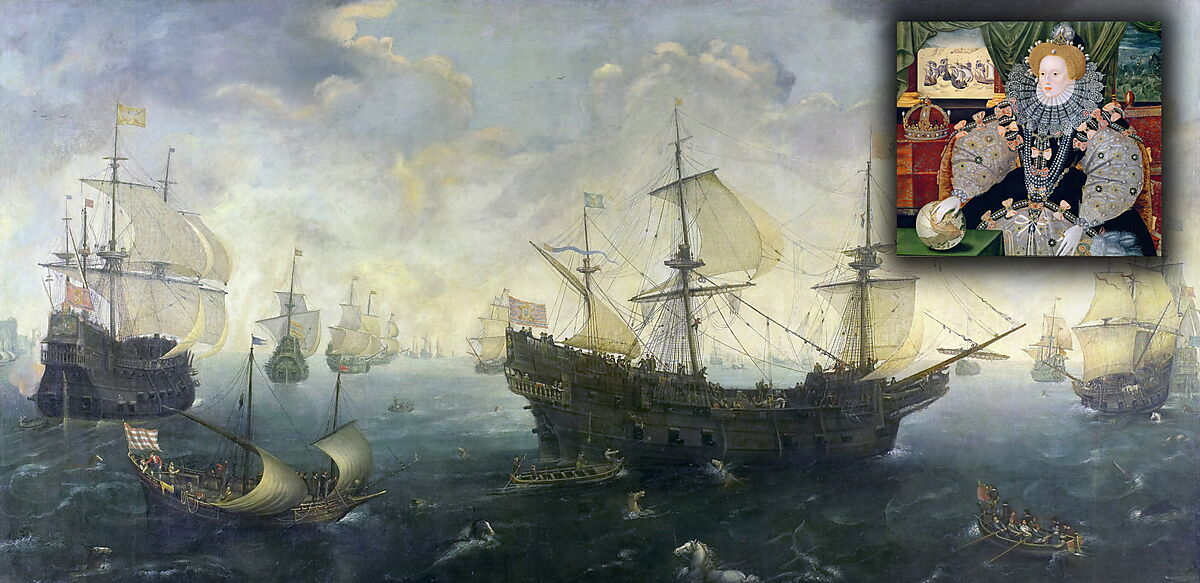
The Spanish Armada off the English Coast
Queen Elizabeth I’s Armada Speech of 1588: An Insight into the Accuracy of the Historical Record
On 9 August 1588 Queen Elizabeth I of England stood at Tilbury, a port on the Thames estuary, to review her army. England was facing the Spanish Armada, and in a speech to rally her troops she declared ‘I may have the body of a weak and feeble woman, but I have the heart and stomach of a king. And a King of England too!’1
Since then this quote has become part of the mythology of Elizabeth, the Virgin Queen. In the immediate aftermath of the Armada, England’s victory was seen as a direct blessing from God. Her popularity soared. Poems such as James Aske’s Elizabetha Triumphans, plays and even national prayers across the country referenced Elizabeth’s speech at Tilbury, giving their own versions of events. In contrast to the criticism of her as a woman, a Protestant, possibly illegitimate, her Tilbury performance positioned her as the true and rightful queen, a warrior blessed by God.2
Given the speech was delivered in a fraught environment, it is remarkable that it survived. We owe its survival to a certain Dr Lionell Sharpe, chaplain to the Earl of Leicester, commander of Tilbury Camp. Sharpe wrote down the speech as he heard it, and read it out the next day to those soldiers who were not present on the day.
Following Sharpe’s death in 1631, the transcript appears to have passed into the possession of Robert Harley, Earl of Oxford, a keen collector of historical political manuscripts (a fashionable hobby of the time). In 1753 when Harley’s estate was sold to the English Nation, Sharpe’s transcript entered the archival collection of the British Library, where it now resides. The transcript was bound in a volume of letters from different people across several decades; the evidence linking it to its original author, the context, and purpose were lost as a result.
Piecing together the evidence, we find that the transcript is messily written — in keeping with someone taking down a speech in the middle of a crowd. The document is accompanied by a note stating that it was ‘gathered by he who heard it and was commanded to utter it to the whole army the next day’,3 which fits with Sharpe’s own account of events. The handwriting itself appears to match the writing on a letter from Sharpe to the Duke of Buckingham. This letter was written 35 years after Tilbury (in 1623), and was later published in a collection called The Cabala: Mysteries of State (1654). This letter has good archival provenance, which means there is enough contextual evidence to ascertain that it is indeed an authentic communication between these two men.
Although the transcript appears to be genuine, could Sharpe have embellished or otherwise fabricated parts of the speech? In his letter to Buckingham, Sharpe cites Elizabeth’s words to evoke passion for English nationalism — in particular to argue against the proposed marriage between England’s Charles I and the Infanta Maria-Anna, daughter of King Philip III of Spain.
Continental Europe at the time was embroiled in the Thirty Years’ War (1618–48), with Catholic Spain striving to prevent the Holy Roman Empire from falling into Protestant hands. For the English, a marriage alliance with Spain would leave the country vulnerable to Catholic hegemony. By invoking England’s triumph of 1588 over the Spanish Armada, Sharpe, a Protestant chaplain, advocates English Protestant unity as exemplified by Elizabeth’s rousing words. Seen in this light, Sharpe certainly had the incentive to embellish the speech.
To uncover the nature of any potential embellishment, we can draw upon a second version of the speech found in a sermon by William Leigh, a minister active around 1612. Its origins are unclear, and Leigh himself acknowledges that his sermon was some approximation of Elizabeth’s words.4 In Leigh’s sermon, we find the equivalent passage phrased rather as ‘The enemie perhaps may challenge my sexe for that I am a woman, so may likewise charge their mould for that they are but men, whose breath is in their nostrels, and if God doe not charge England with the sinnes of England, little doe I feare their force.’5 This account holds forth on a similar theme but lacks the bold personification of England through Elizabeth’s ‘body of a weak and feeble woman […] the heart and stomach of a king’. Sermons commonly reflected the political leanings of the orator at this time, and it is possible that Leigh could have changed the wording to suit his purpose.
Without further evidence it is possible that Sharpe, Leigh or both men wrote accounts from little more than gossip and hearsay, in which case Elizabeth’s exact words at Tilbury are likely never to be known.
Records in archives are usually seen as trustworthy. If they are not outright forgeries, they are generally taken as an accurate reflection of the events they describe. However, close scrutiny can sometimes reveal the accuracy of a historical source to be uncertain and almost impossible to come by.
Notwithstanding, Elizabeth’s speech has echoed down history, taught in textbooks for generations and quoted (and misquoted) in films and books, from Blackadder (1986) to Elizabeth:The Golden Age (2007).
References
- British Library. "Elizabeth I's Tilbury speech". British Library. 2022
- Janet Green. "‘‘I My Self’: Queen Elizabeth I’s Oration at Tilbury Camp". The Sixteenth Century Journal. 28, no. 2. 1997. pp. 421-445. 421–445
- Janet Green. "‘‘I My Self’: Queen Elizabeth I’s Oration at Tilbury Camp". The Sixteenth Century Journal. 28, no. 2. 1997. pp. 421-445. 440
- Susan Frye. "The Myth of Elizabeth at Tilbury". The Sixteenth Century Journal. 23, no. 1. 1992. pp. 95–114. 104
- Susan Frye. "The Myth of Elizabeth at Tilbury". The Sixteenth Century Journal. 23, no. 1. 1992. pp. 95–114. 101–102

Working in archives gave me the chance to see ‘behind the scenes’ at how history is researched, and the often complicated paths that make those records available. This really sparked my interest in tracing the origins of the documents from which we know history. Queen Elizabeth I is one of my favourite historical figures, so it was a natural choice to investigate one of her most well-known quotes, and to question its authenticity.— Claire Parker