
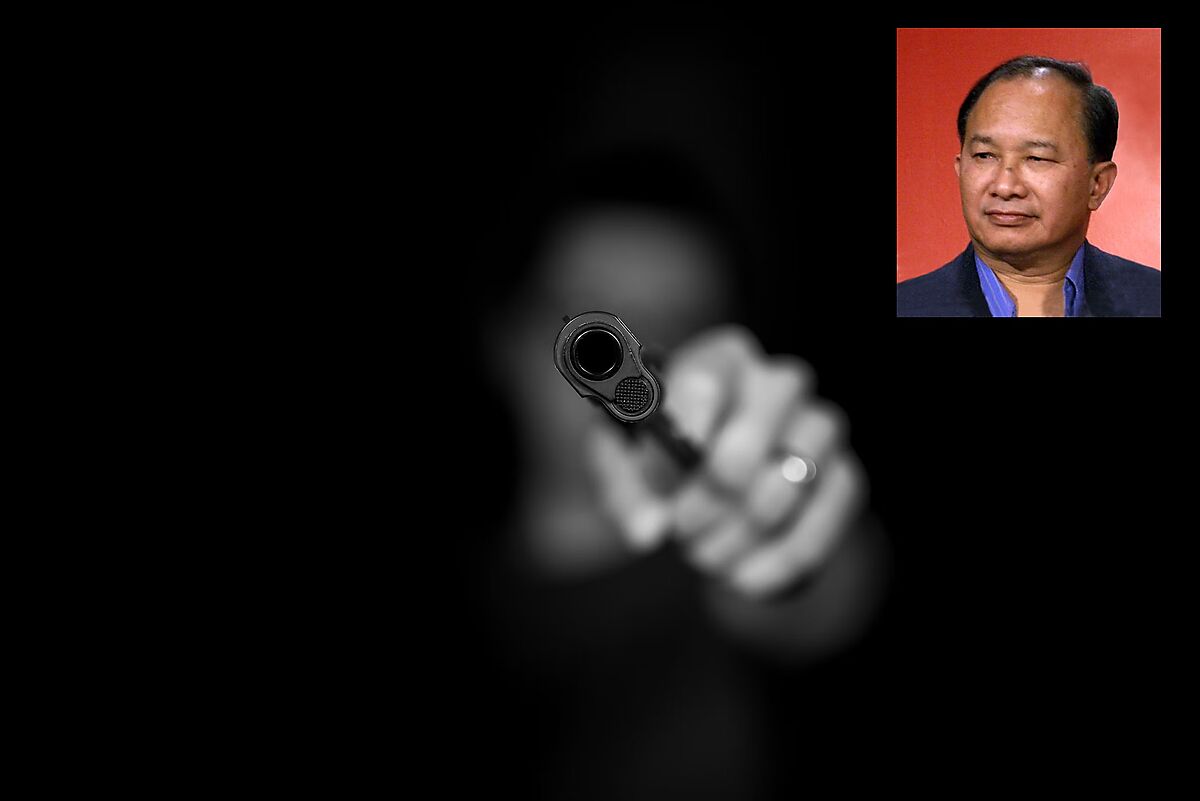
Gun in Greyscale and John Woo (inset)
John Woo and the Origins of Heroic Bloodshed
In 1946 in the midst of the Chinese civil war, John Woo was born as Wu Yu-seng to Christian parents in Guangzhou, a port city in China. Five years later the family fled to British-controlled Hong Kong (which lies just across the Zhujiang River Estuary) to escape the rise of the Communist Party under Mao Zedong. There the family endured extreme poverty in the slums of Shek Kip Mei and were rendered homeless for a time when a fire destroyed their shanty town in 1953. The public housing system that replaced the slum was subject to growing violence and crime, and the young Woo would seek salvation in either the local church or at the cinema.1 Woo’s mother would take him to see musical films popular at the time such as Singin’ In the Rain (1952), The Wizard of Oz (1939), and the works of the American dancer Fred Astaire.
Woo started making his own moving images by drawing images on glass and projecting them onto a wall with a torch.2 He was shy as a child and in filmmaking he saw a means of expressing himself. After attending university for a brief spell, Woo dropped out from a lack of funds and started work as a script supervisor at Cathay Studios. Woo found fascination in the stylish crime thrillers of Jean Pierre Melville and Francois Truffant, two prominent filmmakers of the French New Wave, and through that inspiration started making experimental short films in his spare time with a group of friends.3
The Hong Kong box office was dominated by Kung Fu and Wuxia (historical action drama) produced by the dominant Shaw Brothers Studios and its main competitor, Golden Harvest (for whom Bruce Lee, the legendary Kung Fu star created his iconic films). Woo started his career at Shaw Studios as an assistant director in the late 1960s. There he came under the influence and mentorship of Chang Cheh, one of the most important figures of Hong Kong cinema, with whom Woo worked on films such as The Water Margin (1972) and Boxer from Shantung (1972), which would become classics of the genre. Woo would call Cheh his greatest inspiration, and the Cheh-esque themes of brotherhood, loyalty, and honour would form the bedrock of Woo’s filmmaking.4
In 1974 Woo made his directorial debut in The Young Dragons, a film he made for Golden Harvest, which while achieving only moderate success show Woo’s ability to tell a story in a more exciting way using fast-paced action sequences effected through rapid camera movement and quick cuts.
The next 12 years were a formative period for Woo, but his work remained anchored in conventional Kung Fu fare. Woo realised he needed a fundamental change in approach to achieve his artistic vision of making ‘dramas from the heart’ — in the style of his paragon Jean Pierre Melville.5 This change materialised when Woo pitched an idea for a stylish yet violent film to Tsui Hark, a legendary Hong Kong producer/director. Hark was convinced by Woo’s vision and financed him with a small budget. The resulting A Better Tomorrow (1986) tells the story of Sung Tse-Ho, who runs a criminal operation for a Hong Kong triad (a secret criminal organisation) printing counterfeit American dollars, which he manages with his best friend and business partner, Mark Lee. Ho’s younger brother, unaware of his criminal activities, graduates high school and joins the police force.
In A Better Tomorrow Woo broke new ground by combining light weapons such as Barettas and Uzis in the hand-to-hand combat sequences, allowing for greater mobility and fluid Kung Fu action sequences — which eventually gave rise to the term ‘Gun-Fu’. Woo also took a visual cue from Melville to put his characters in sleek European suits, reminiscent of a fashion shoot in GQ, the men’s magazine. These contrasted with the smart everyday outfits worn by the popular Hong Kong actor Jackie Chan in his films or the repetitive and drab student robes featured in standard Kung Fu fare. The innovative wardrobe design was credible to the extent that duster coats were referred to as ‘Mark Gor Lau’ (Brother Mark’s coat) in Cantonese slang by teenagers of the time.
Thematically A Better Tomorrow broke new ground in its examination of brotherhood, in the sense that Ho and his brother Kit, together with Mark all belong to the same triad family, and the dramatic tension builds on their bonding to combat external forces. Woo handles the subjects of revenge and family by positioning them as narrative priorities, building audience empathy for the trio’s survival. This differed from the status quo of Hong Kong filmmaking where narrative was often seen as a lesser priority to action.
Upon its release, the combined innovations took Hong Kong audiences by surprise and the film was a critical and commercial success; it is now cited as a classic. Later, film critic Rick Baker would coin the term ‘Heroic Bloodshed’ to describe the action. Eventually this would coalesce into a whole new subgenre — inherently describing Woo’s style.6 The ‘heroic’ aspect refers to the brotherhood, honour, duty and redemption traits; while the ‘bloodshed’ refers to the graphic but stylised violence effected through shootouts, stabbings, and explosions.
The protagonist of the heroic bloodshed subgenre is usually a criminal who is also prone to surprisingly compassionate behaviour; or a policeman with an unshakeable moral code in the mould of hardboiled American screen detectives such as Kojak or Dirty Harry. Both criminal and police officer suffer great physical and mental trauma in their rigid adherence to their principles, with death, prison, or significant injury showing the audience the human cost of doing the right thing.7
Woo’s heroic bloodshed films are also underpinned by Christian morality so that despite their graphic violence there is a strong sense of forgiveness and tolerance, and his films often feature churches and Christian iconography such as crucifixes.
Woo would go on to further define the subgenre with The Killer (1989), A Better Tomorrow II (1987,) and Hard Boiled (1992). Like Bruce Lee before him Woo’s individual success inspired other directors to develop their own heroic bloodshed films, with notable examples being Ringo Lam’s City on Fire (1987), Johnnie To’s All About Ah-Long (1989), and Wong Kar Wai’s Fallen Angels (1995).
In the West, directors Quentin Tarantino, Luc Besson, and the Wachowski Sisters would cite Woo as an influence in their own careers. In Tarantino’s debut, Reservoir Dogs (1992), the plot is inspired by City on Fire and the iconic black suits are a nod to A Better Tomorrow II. In Besson’s La Femme Nikita (1990) the pistol-ballet style choreography is inspired by heroic bloodshed and the moralistic assassin protagonist of Leon the Professional (1994) is in the mould of actor Chow Yun Fat in Woo’s The Killer. The use of slow motion and cutting in the Wachowski Sisters’ The Matrix series (1999–2003) is another example of Woo’s style. The heroic bloodshed subgenre continues to thrive in recent films such as Gareth Evans’s The Raid (2011) and Chad Stahelski’s franchise John Wick (2014–2023).
These citations by well-known directors helped John Woo to forge a successful career for himself in the United States in the late 1990s–2000s with films such as Face Off (1997) and Mission Impossible II (2001) — a remarkable journey for a boy who only found cinema as a means of escaping his crime-ridden neighbourhood.
References
- Dave Kehr. "For the Auteur of Action, a Thoughtful Turn". The New York Times. 2002
- Alex Simon. "John Woo The Hollywood Interview". The Hollywood Interview. 2008
- Katie Rife. "Heroic Bloodshed: John Woo on action with a beating heart". Letterboxd. 2022
- Nev Pierce. "John Woo, Getting Direct With Directors". BBC. 2004
- Alex Simon. "John Woo The Hollywood Interview". The Hollywood Interview. 2008
- Jillian Sandell. "Interview with John Woo". Tony Leung. 2001
- Jillian Sandell. "Reinventing Masculinity: The Spectacle of Male Intimacy in the Films of John Woo". Film Quarterly. 4, no. 49. 1996. pp.23–24. 23
My interest in John Woo stemmed from articles and interviews with other directors, which made me realise that he is a hero to some of my heroes. This made me curious to see his work for myself and to understand his impact on Hong Kong cinema. Influenced by directors like Melville, Scorsese, and Peckinpah, Woo developed his own style bringing cool into Hong Kong cinema both in terms of the general aesthetic and his fluid, exciting, precisely choreographed action sequences. This new sophistication fascinated audiences who turned away from the rapidly stagnating Kung-Fu genre to Woo’s brand of designer action.— Simon Thompson