
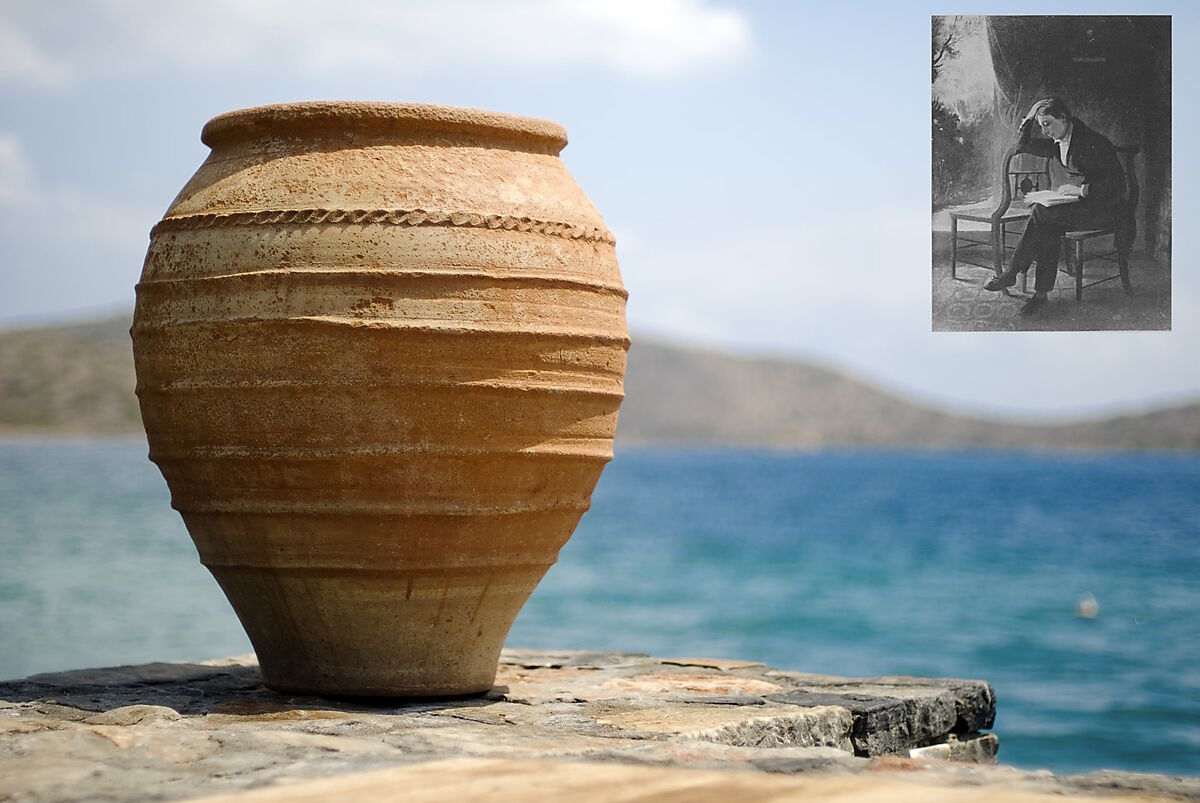
Grecian Urn & John Keats (inset)
John Keats’s ‘Ode on a Grecian Urn’ (1820) — Ekphrasis as a Vessel of Impossibility
In John Keats’s ‘Ode on a Grecian Urn’ (1820), the speaker describes the static pastoral life of the figures of an imagined urn as he moves around its cyclical shape. Born in 1795 to a working-class family, unlike the placid beauty of the urn, Keats’s life was tragically calamitous.
Keats was sent at the age of seven in 1803, together with his younger brother George, to Reverend John Clarke’s boarding school in Enfield, a liberal school whose students were encouraged to read voraciously, with particular encouragement to read the classics. This interest in the classics was essential to the development of Keats’s poetic identity. According to an anecdote from 1816, Keats and his friend Charles Cowden Clarke spent an entire night reading Chapman’s translation of Homer’s Iliad and Odyssey. Early next morning, Clarke found the first draft of Keats’s poem ‘On First Looking at Chapman’s Homer’, an exuberant sonnet hailing his joy at reading Homer.1
Despite these moments of joy, Keats’s life never strayed far from death and suffering; by the age of 14, he had already lost his younger brother Edward and both his parents. Anguished by financial hardship and the ill-health of his youngest surviving brother, Tom, Keats’s transition to a full-time poet was not easy. In 1818, Keats moved into Wentworth Place in Hampstead, London with his friend, Charles Brown. Fanny Brawne was Keats’s neighbour who often came to visit her friends the Dilkes who rented half of Wentworth Place. Lively and fashionable, Fanny fascinated Keats and helped him grieve after Tom finally succumbed to tuberculosis in 1818. Keats proposed to Fanny in October of that year.
The English Romantic poets, of which Keats would become a prominent member, found in the art, literature and mythology of Ancient Greece and Rome a wellspring of inspiration. They saw the classical past as a symbol of artistic perfection, often using it to critique the societal norms and political injustices of their own time.
A form sometimes exploited by the Romantic poets to interrogate the past was ekphrastic poetry. In the simplest sense ekphrasis is the poetic description of a work of art, although it is sometimes expanded to encompass all verbal descriptions ‘intended to bring person, place, picture, etc. before the mind’s eye.’2 Ekphrasis is formed from the Greek ek, meaning ‘out’, and phrasis, meaning ‘speech’ — essentially to bring something forth through speech. The term originates in Homer’s descriptions of the warrior Achilles’s shield in the Iliad. These intricate descriptions, from mundane farmers’ fields to a city besieged, ‘give us at once both the elaborately ornamented metal artefact and the routine material life of ancient Greece’.3
Keats wrote ‘Ode on a Grecian Urn’ (1820), an ekphrastic poem, two years after meeting Fanny Brawne. The same dualism, as found in Homer’s description of the inanimate Achilles’s shield, is true of Keats and the urn which is at once a description of a still object, and an interrogation of the urn’s immortal perfection, arising from the living pen of the poet trying to capture its stillness.
The poem begins:
Thou still unravish'd bride of quietness,
Thou foster child of silence and slow time 4
Through personifying the urn as a ‘bride’ and ‘child’, names of transition associated with change and growth, the speaker uses human temporality to stress the otherworldly stillness of the urn. Keats contemplates this idea further when he describes the fervour of a young man in pursuit of his beloved.
Bold Lover, never never canst thou kiss,
Though winning near the goal yet, do not grieve;
She cannot fade, though thou hast not thy bliss,
For ever wilt thou love, and she be fair! 5
The static figures on the urn represent a moment of infinite anticipation; they exist on the cusp of union and vitality yet are simultaneously thwarted by the reality of their material existence as figures on an object of art. However, Keats explores the inherent possibilities of a work of art:
Heard melodies are sweet, but those unheard
Are sweeter; therefore, ye soft pipes, play on;
Not to the sensual ear, but, more endear’d,
Pipe to the spirit ditties of no tone:6
He finds the sound conjured up by his imagination much ‘sweeter’, discovering beauty in the urn’s stillness in what is left unsounded. These potentials are more provoking to the imagination than the familiar sensations of life.
Keats examines this silence further in the next scene where he describes an emptied town whose inhabitants have departed to another plane of the urn to attend a sacrifice.
And little town, thy streets for evermore
Will silent be; and not a soul to tell
Why thou art desolate, can e’er return 7
Unlike the previous silent melodies which delighted the poetic imagination, the abandoned town oppresses the speaker, forcing him to dwell on the implications of the urn’s beauty; the eternal urn is beautiful because it is estranged from mortality. But as the figures can never grow old, so too will their town always remain bereft.
The poet’s struggle to animate the depleted town marks his sudden realisation of the stark divide between ancient beauty and breathing life. Whilst the urn is beautiful, its beauty is too still, too unliving for the poet to fully breathe life into through words alone. This rounds on the limitations of ekphrasis as a form: words describing a work of art can never truly conjure up the work of art itself.8 The written and visual mediums are too different. And so too is the beauty of the still Grecian urn and the living word. Ekphrasis, then, can be considered a vessel of impossibility, an impossibility that is symbolic of the Romantic struggle to return to ancient Greece.
Keats’s musings on the timeless beauty of the Greek urn reflect his own fragile mortality. In the same year in which he wrote the poem, after suffering several months with the symptoms of tuberculosis, Keats travelled to Rome to prevail upon Italy’s warmer climate. Three months after arriving in Rome, at the age of 25, Keats succumbed to his illness.
References
- Charles Cowden Clarke and Mary Cowden Clarke. Recollections of Writers. London: Sampson Low, Marston, Searle, and Rivington. 1878. p.130
- George Saintsbury in Jean Hagstrum. The Sister Arts: The Tradition of Literary Pictorialism and English Poetry from Dryden to Gray. Chicago: Chicago University Press. 1968. p.18
- Kreiger Murray. Ekphrasis: The illusion of the Natural Sign. Baltimore: John Hopkins University Press:. 2019. p.18
- Polly Prior (ed.). Inspiration John Keats Poetry. London: Flame Tree Publishing. 2019. p. 38
- John Keats. "Ode on a Grecian Urn". Poetry Foundation. 2024
- John Keats. "Ode on a Grecian Urn". Poetry Foundation. 2024
- John Keats. "Ode on a Grecian Urn". Poetry Foundation. 2024
- William Mitchell. "Ekphrasis and the Other". South Atlantic Quarterly. 91, no. 3. 1992. 695-719. p. 698

I have always been fascinated by Keats as a figure of tragedy and brilliance. His poetry harbours such a vivid sense of vitality and spirit that words never seemed to impede the rich velvety imagery he wished to convey to the reader. In his ‘Ode on a Grecian Urn’ I saw a different side to Keats. I witnessed his struggle to put into verse the inanimate, that which was not breathing. This encouraged me to delve deeper into the challenges he faced.— Holly Faulkner