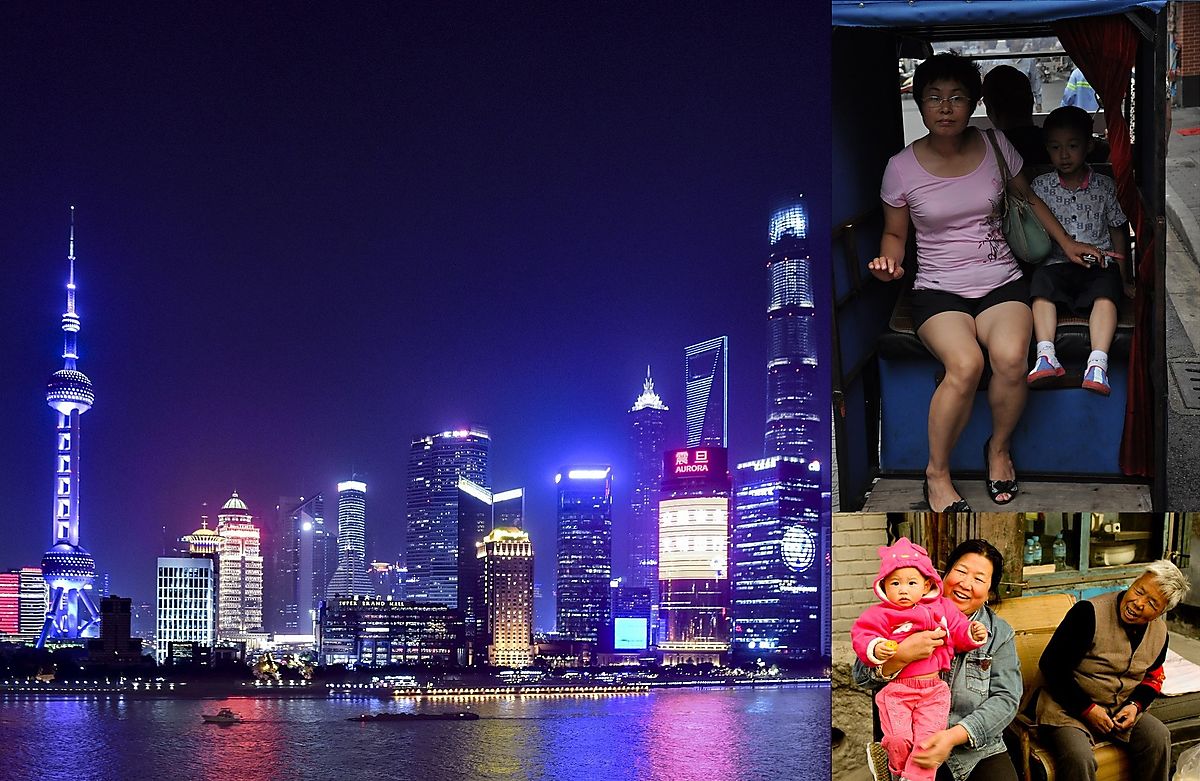
This work, ‘Shanghai and Chinese Parents’, is a derivative of ‘Shanghai Waitan’, ‘Mother and Child in Rickshaw, Shanghai’, ‘Chinese Family’ used under CC BY. ‘Shanghai and Chinese Parents’ is licensed under CC BY SA 4.0 by The Cultural Me
A traditional Chinese parable recounts the tale of a poor man willing to bury his own infant so that there is enough food for the man’s ageing mother. He is soon thwarted and rewarded with a pot of gold.1 This idea of filial piety is a fundamental principle of Chinese society, exemplified by the Confucian principal (philosopher, 551–479 BCE) that children hold an eternal obligation towards their parents for their upbringing.2
Yet in recent years this obligation has witnessed a reinterpretation as parents seek greater economic success, leaving childcare duties increasingly on the lap of grandparents.
In today’s China, grandparents share almost half the childcare duties for children aged 2–3.3 One report in Shanghai found that around 90% of the city’s young children were cared for by a grandparent.4 This can extend to longer periods of absence for children in rural areas, who remain under the care of grandparents whilst their parents head off to affluent cities in search of work.5
In many families, this arrangement has reaped benefits — particularly for women. In China, 51% of senior management positions are held by women (compared with 24% globally), and the country is now home to half of the world’s female self-made billionaires.67 Studies have acknowledged the role of grandparents in providing a valuable foundation for China’s rapid economic growth.8
Depending on one’s parents in their old age clearly goes against the Confucian ideal of filial piety. Yet, through the freedom that greater wealth brings, China’s working parents are now able to provide for their children and their parents, offering them a way to meet modern demands whilst keeping family at the heart of what they do.
R. L. Littlejohn. Confucianism: An Introduction. London: Bloomsbury Academic. 2011. 139-140
Conor Lewis
London, UK
During my visits to China in recent years, I have been amazed by the fast-paced energy of modernisation in cities such as Shanghai and Shenzhen. The Chinese economy is growing at a pace, with an increasingly diversified workforce. These experiences drew me towards writing this piece, in which I look to explore the impact of modernity on traditional values within Chinese society.