
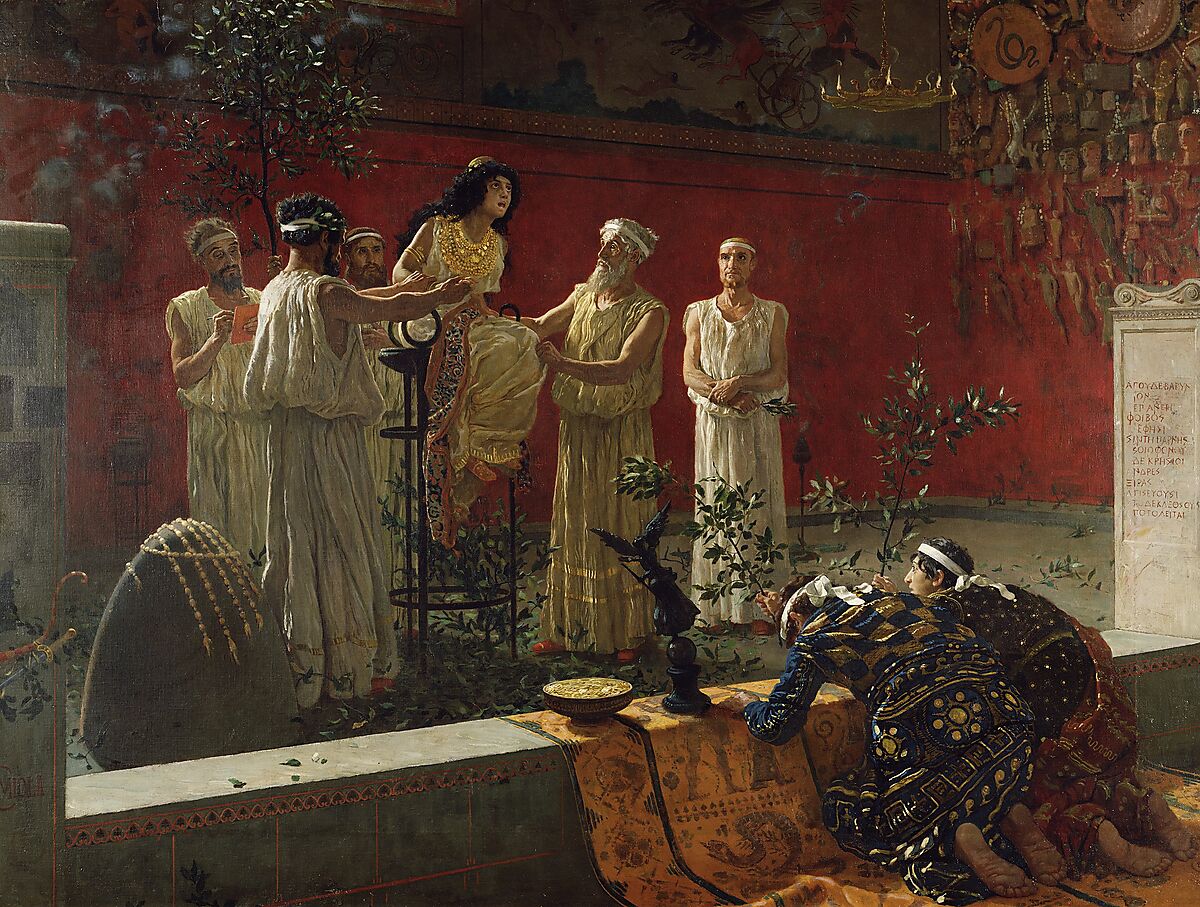
Camillo Miola, The Oracle, 1880
Cassandra and the Oracle at Delphi — Unearthing the Ancient Distrust of the Female Voice
Zeus, the king of the gods, had identified Delphi, nestled on the slopes of Mount Parnassus high above the Gulf of Corinth, as the very centre of the world. It was here that Apollo in his role as god of prophecy chose to foretell the future, and the establishment of his shrine at this unique location helps us understand the importance the ancient Greeks attached to the practice of prophecy.
The incumbent priestess of his shrine at Delphi, who was referred to either as the Pythia or the Oracle at Delphi, having purified herself, would enter the basement of the shrine and there sit upon a sacred tripod. In preparation, she would chew on laurel leaves and enter an ecstatic trance-like state after breathing in fumes which emanated from the earth at that spot. She would then deliver her prophecy to a cohort of male priests who would transcribe her sayings before translating and presenting her message in verse to the person consulting the oracle.
The gift of Apollo’s prophecy was also bestowed upon a second female, the mythological figure of Cassandra. In Homer’s epic poem the Iliad (8th century BCE), she is the daughter of King Priam of Troy and his wife Hecuba. Her legend is further elaborated upon in the works of the dramatist Aeschylus (525/524BCE–456/455BCE), in which she is given the ability to foresee the future. However, according to Aeschylus, after she rejects Apollo’s sexual advances he places a curse on her to the effect that her prophecies will never be believed by those around her.
The Oracle at Delphi enjoyed an enormous degree of popularity and authority. At its most influential, in the sixth and fifth centuries BCE, the oracle’s pronouncements were regularly sought by kings and cities on important matters of state. Croesus, king of Lydia, consulted the oracle three times regarding war with Persia; Lycurgus, the Spartan lawgiver, consulted her before applying new laws in Sparta; and Solon, the Athenian statesman, only introduced his transformative constitutional reforms after a visit to Delphi. Such was its importance that wars were fought for control of the oracle until in 595BCE the Temple of Apollo came under the protection of the Amphictyonic League, an alliance of neighbouring Greek city states.
The prophecies of the Oracle at Delphi were sufficiently opaque as to appear correct in any eventuality. When King Croesus consulted the oracle in around 547BCE, he was advised that war with Persia would result in the destruction of a great empire, spurring him on. However, he failed to foresee that it was the destruction of his own empire that was predicted. The oracle’s voice had also been accused of partiality — on one occasion coming out on the side of the family of Alcmaeonidae, who were generous donors, by urging the Spartans to reinstate their rule in Athens by driving out the incumbent tyrants.1
Cassandra’s role as prophetic priestess is notably influential in the development of the Trojan War mythology cycle. In Euripides’s play Andromache (428BCE), the Chorus refers to Cassandra’s prophecy that her brother Paris will be responsible for Troy’s downfall and that she has called for his death.2 Her warnings are disregarded and it takes the repetition of her prophecy by her half-brother, who interprets a dream, for the people to leave the young Paris exposed to the elements to die. The timely and fateful intervention of a shepherd ultimately spares Paris’s life. In Virgil’s epic poem, the Aeneid (19BCE), which recounts a number of episodes from the war itself, Cassandra urges the Trojans not to bring the Trojan Horse inside the city gates, knowing it will bring destruction upon her people but again no one believes her. The Trojan hero Aeneas bitterly regrets that they did not see the truth of her warning. Cassandra’s prophetic gift is also explored in Euripides’s Trojan Women (415BCE) and in Aeschylus’s Agamemnon (458BCE), both of which deal with the aftermath of the Trojan War. In Aeschylus’s tragic tale of Agamemnon’s homecoming, Cassandra, awarded to Agamemnon as part of the spoils of war, foresees both his and her own death. Both Euripides and Aeschylus present her as a figure who is tormented by the knowledge that she is effectively ostracised as a result of her ‘lies’. When she predicts Agamemnon’s death, the Chorus cannot comprehend what she means:
Cassandra: Yet I speak good Greek.
Chorus: The oracles of Delphi are good Greek,
But hard to understand.3
Here we see Aeschylus explicitly linking the two prophetesses: Cassandra and the Oracle at Delphi.
The Oracle at Delphi and Cassandra were accorded a great deal of honour in their roles as chosen representatives of Apollo. Yet their individual characters are inextricably linked with the notion of unreliability. The significant fact that both were female is symbolic. In a society where women predominantly led domestic lives, lacked a voice in the public sphere, and were confined to roles within the religious domain as priestesses, it is indeed revealing that these prominent female figures have been tarnished with the reputation of untrustworthiness. The literature of ancient Greece is foundational to Western literature. One can conjecture, therefore, that the negative portrayal of these women in their roles as speakers may have been influential in fostering societal suspicion towards the female voice beyond that original ancient setting.
The desire for prophecy is underpinned by the essential human fascination with knowing the future and the realisation that this pursuit is ultimately an impossible task. It accounts for the widespread popularity and authority of the shrine at Delphi and explains why that popularity endured long after genuine belief in its credibility had faded. That the functioning of Cassandra and the Oracle became almost synonymous with ambiguity and uncertainty — even misleading to the point of destruction — reflects not only the ancient distrust of the female voice but also underscores the futility of ever truly divining the future.
References
- Herodotus. The Histories. Penguin: . 1983. p.364
- Euripides. "Euripides, Andromache, Line 293". Perseus Digital Library. 2024
- Betty Radice (ed.). Aeschylus. The Oresteian Trilogy. London: . 1988. p.86

Despite having studied and taught Classics for many years, it was only last year that I had the opportunity to visit Athens in Greece for the first time. The magnificent remains of ancient buildings such as the Parthenon were impressive but I was completely enchanted by the daytrip I took to Delphi. The ruins of this sacred site are striking in their mountainous surroundings and the contrast of the golden stone and the green woodland give the area a truly peaceful and magical quality. This episode reignited my interest in the stories surrounding this ancient shrine and its oracle.— Mary O’Reilly