
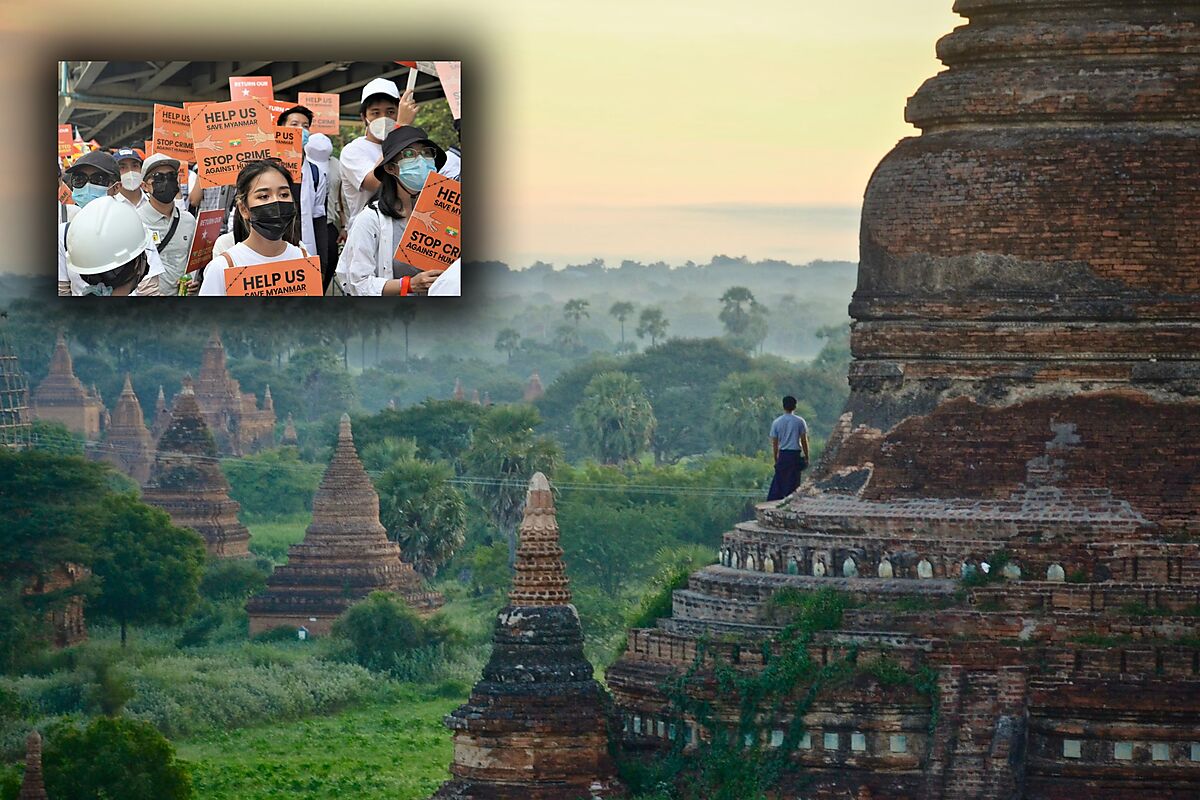
Bagan, Myanmar and Protests in Yangon (Inset)
Burma versus Myanmar — A Brief History of a Country’s Name
The people of Burma have endured many changes enforced upon them by the military regime that governs them. In 1970, they were forced to start driving on the right side of the road instead of the left, apparently on the advice of military dictator Ne Win’s astrologer. During the period 1985–87, the government demonetised some of its banknotes and introduced replacements in obscure denominations, again for possibly astrological reasons, destroying the cash savings of many Burmese. In February 2024, the regime announced a military conscription of 18 to 35 year-olds to bolster its depleted troops in the war against the many active insurgent groups. One of the most controversial changes, however, occurred in 1989 when the military decided to rename the nation ‘Myanmar’, claiming it would help unite the country’s ethnically diverse population.
Burma’s rich ethnic diversity emerges from its location — bordered as it is by India, Tibet, China, Laos, Thailand, and Bangladesh. In the 11th century, the landmass now known as Myanmar was unified under a single sovereign for the first time as the Kingdom of Pagan. The kingdom was home to many ethnic groups, including the Bamar, Shan and Karen people. The Bamar were the dominant ethnicity, leading to the widespread adoption of the Bamar language (Burmese) and culture. In the following centuries, the land was ruled by a succession of empires, eventually coming under British rule in the 19th century. The British divided the country into Ministerial Burma and the Frontier Areas, the latter mostly consisting of loosely governed ethnic minority populations. During this period, the country was officially named Burma.1
Ethnic division has been the main contributing factor to Myanmar’s instability throughout its history. Ethnic rivalries that were dormant during colonial rule came to the fore after independence from Britain, which was achieved on 4 January 1948. Despite assurances by Aung San, the leader of the Burma Socialist Party who negotiated independence, ethnic minorities found themselves subjected to the imposition of Burmese language and culture, regardless of whether they spoke or identified with it.2 The situation worsened after 1962 following a military coup under the leadership of General Ne Win, which marked the onset of decades of military rule in the country. The military regime has been accused of systematically instilling suspicion of ethnic minorities amongst the Bamar majority as a means of control and suppression.
In 1988, economic hardship, political repression, and widespread discontent with the military regime sparked what became known as the 8888 Uprising (named after 8 August 1988, the date on which key events of the uprising took place). The uprising was suppressed and the country was ruled by an authoritarian military junta known as the State Law and Order Restoration Council (SLORC) for the next ten years.
It was the SLORC’s decision to change ‘Burma’ to ‘Myanmar’ as part of a broader campaign to promote Burmese nationalism, which included removing references to the colonial era; the name ‘Burma’ is a British corruption of the word ‘bamar’. As part of its 'Burmanisation’ campaign, the government changed the then-capital city’s name from Rangoon to Yangon and replaced British street names with Burmese equivalents.
The SLORC also suggested that ‘Myanmar’ was more ‘ethnically inclusive’, as ‘Burma’ only refers to the country’s majority ethnic group and disregards ethnic minorities.3 However, this is not true. Burmese is a diglossic language, meaning it has two different registers (or styles): colloquial, which is used in informal contexts, such as in conversations or letters amongst friends, and literary, which is used in formal documents, literature and newspapers. The two names simply exist on the different registers: ‘Bamar’ is the colloquial name for the country and the ethnic majority, while ‘Myanmar’ is the literary form of the same word.
For Myanmar’s ethnic minorities, then, there is no significant difference between ‘Burma’ and ‘Myanmar’. The Burmese military promotes and exploits nationalist sentiment in order to appeal to the majority ethnic Bamar, whose members make up most of the military itself.4 A move towards ethnic inclusivity, therefore, seems at odds with its strategic objectives. On the contrary, the military is accused of repeatedly violating the rights of ethnic minorities, including attempts to erase ethnic language and culture (such as through the imposition of Burmese spellings on place names), and the barring of Burmese citizenship for some groups such as the Rohingya, whose members it sees as illegal immigrants from Bangladesh.
The renaming of the country, if not a step towards inclusivity, could, however, convey new intentions — namely a drive by the military to improve Burma’s image on the international stage. Following the 8888 Uprising, the SLORC recognised the advantages of building relationships with foreign powers, and in the ensuing years proceeded to make arms deals with India and China, and take steps towards opening up the country to foreign investment.5
However, both domestically and internationally, many organisations, rebel groups, and even some countries refuse to recognise ‘Myanmar’ as the country’s name because they reject the military’s authority to make such a change; the USA, for example, continues to use ‘Burma’ officially. Many countries only accepted the name during Myanmar’s apparent transition towards democracy in 2011. While former US president Barack Obama adopted the name ‘Myanmar’ during his visit to the country in 2012, President Joe Biden has reverted to ‘Burma’ following the 2021 coup which once again tipped the country into civil unrest. While superficially it may seem that those using ‘Burma’ are clinging to an antiquated colonial name, it is in reality seen as an act of rebellion against the authority of the military junta.
Three years on from the 2021 coup, the conflict within Myanmar persists. Clearly, the complexities of this country and its conflicts go far beyond a name, but the question of Burma or Myanmar provides an insight into the deep historical rifts within the country.
References
- David I. Steinberg. Burma/Myanmar: What Everyone Needs to Know. Oxford: Oxford University Press. 2010. p. 21
- David I. Steinberg. Burma/Myanmar: What Everyone Needs to Know. Oxford: Oxford University Press. 2010. p. 57
- David I. Steinberg. Burma/Myanmar: What Everyone Needs to Know. Oxford: Oxford University Press. 2010. p. 10
- Richard C. Paddock. "For Myanmar’s Army, Ethnic Bloodletting Is Key to Power and Riches". The New York Times. 2018
- David I. Steinberg. Burma/Myanmar: What Everyone Needs to Know. Oxford: Oxford University Press. 2010. p. 94

I chose to write this article because, as someone who has both studied and lived in Burma, the most common question I’m asked about the country is ‘what are we supposed to call it?’ There are so many misconceptions about which is the ‘right’ name; and the origins and rationale of each. I wanted to write my own take on the answer and how it reflects the country’s inner turmoil.— Jemma Stewart