
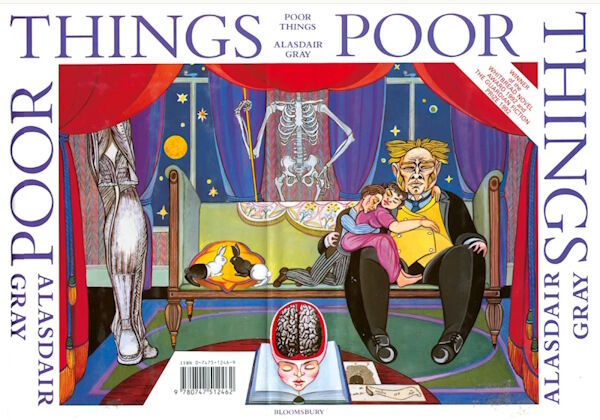
Book Cover: Poor Things (1992)
Between Modernism and Postmodernism: Alasdair Gray’s ‘Poor Things’ (1992) and the Second Scottish Literary Renaissance
To hold a copy of Alasdair Gray’s Poor Things (1992) in your hands is to hold both literature and art. A graduate of Glasgow’s School of Art, Gray incorporated his own illustrations into his novels, using drawings to disrupt the written narrative.
Earlier, when Gray’s debut novel, Lanark (1981), appeared, Scottish literature was on the cusp of a second renaissance. The first Scottish Renaissance, led by poet Hugh MacDiarmid and others after WW2, had focused on reviving the Scots language and regional dialects. This renaissance was influenced by modernism, a literary movement that broke from traditional realism, favouring experimental forms, fragmented perspectives, and subjective truths. Modernism arose in the early 20th century in response to the political and existential upheavals of the Great War (which shattered prevailing notions of progress and order) and the psychological insights into human consciousness pioneered by Sigmund Freud and Carl Jung.
While modernism sought to create new truths and forms, its successor, postmodernism — emerging disillusioned in the 1950s in the wake of WW2 — rejected the possibility of originality, insisting that everything borrows from or adapts what has come before.
Gray’s playful approach to writing often led critics to place his work firmly within this postmodern camp, as opposed to the rational and serious-minded tradition of modernism. However, in a 1998 interview, Gray described himself as ‘an old fashioned modernist’1; to Gray, postmodernism was an unhelpful and evasive label.2 Yet his dismissal did little to shift public opinion: Poor Things, published in 1992, became quickly established as a postmodern classic.
Poor Things, presented as a discovered manuscript from late-Victorian Glasgow, takes the form of two conflicting narratives, one by Archie McCandless and the other by his wife Victoria, bookended by a fictional editor — Gray himself. In Archie’s memoir he recounts falling in love with Bella Baxter, whom he believes to be the reanimated corpse of a woman whose brain was replaced with that of her unborn foetus by the eccentric surgeon Godwin Baxter. Godwin educates Bella but her thirst for knowledge and experience soon outgrows him; she runs away with the cad Duncan Wedderburn, works as a prostitute in Paris, and eventually returns to marry Archie. Archie concludes his memoir believing their marriage to be content and mutual. What follows is a sharp rebuttal in the form of a letter from Victoria. Victoria claims that ‘Bella’ was an alias invented by Godwin after she abandoned her first marriage. Her version of events dismantles Archie’s account entirely.
These contradictory and unreliable accounts recall narrative techniques pioneered by modernist writers. As fictional editor, Gray immediately foregrounds truth as a central concern, asking whether Archie’s narrative is ‘a blackly humorous fiction’3 or whether Victoria is ‘a disturbed woman who wants to hide the truth about her start in life’.4 Aside from Archie and Victoria, other characters also offer competing versions of the truth. Duncan Wedderburn calls Godwin ‘the Father of All Lies’5 while Godwin dismisses Duncan’s account as ‘exaggerating’ and ‘hideously over-written’6. In Archie’s account, Godwin withholds from Bella the truth about what happened to her child — or so Archie would have us believe. The result is a dizzying novel in which every narrator bends the truth to their own design.
Poor Things also functions as a pastiche of Mary Shelley’s foundational Gothic novel Frankenstein (1818), with Godwin (whose name is a nod to Shelley’s father, William Godwin) standing in for Victor Frankenstein and Bella as his creation. Gray extends this pastiche by inserting fictional reviews of Poor Things into its opening pages. Some are entirely fabricated, while others are so exaggerated that their authenticity is cast into doubt. One, purportedly from the Sunday Telegraph, reads: ‘If Gray had been content either to create a female Frankenstein or to give new zest to the legend of Dr Jekyl and Mr Hyde Poor Things might have been a funny and original tale … But he has loaded his novel with false historical references and larded it with his own gruesome drawings… These are the ravings of second-rate characters in a second-rate novel’.7
Despite Gray’s assertion that he is an ‘old fashioned modernist’, Poor Things in fact emerges as a hybrid text — combining modernism’s concern with subjective truth and interiority with postmodern techniques of parody, pastiche and playful revision.
Gray’s writing marked a turning point in the Scottish literary canon and proved formatively influential for the next generation of writers. Novelist Ali Smith sums up the significance of this experimentation when reflecting on Gray’s role in the literary revival of the 1980s and 90s: ‘Scottish writing was in revolution and Gray was the heart of a literary renaissance which revitalised everything.’8 His commitment to artistic experimentation across forms has led to his enduring reputation as ‘an artist in every form’.9
As a further testament to Gray's resistance to narrative certainty, Poor Things ends not with resolution but with a pointed provocation: authors are never omniscient, truth is always uncertain, and storytelling itself is an act of deliberate artifice.
References
- David Leishman. "True Nations and Half People: Rewriting Nationalism in Alasdair Gray’s <em>Poor Things</em>". Transnational Literature. 6, no. 1. 2013. 1-17. p. 2
- Valeria Polopoli. "Alasdair Gray’s <em>Lanark</em> and (Post-?) Postmodernism". Kwartalnik Neofilologiczny. 61, no. 4. 2014. 663-75. p.663
- Alasdair Gray. Poor Things. London: Penguin Books. 1992. p. XIII
- Alasdair Gray. Poor Things. London: Penguin Books. 1992. p. XIII
- Alasdair Gray. Poor Things. London: Penguin Books. 1992. p. 95
- Alasdair Gray. Poor Things. London: Penguin Books. 1992. p. 83
- A Gray Space. "Book reviews for Alasdair Gray’s novel Poor Things". A Gray Space. 2024
- Ali Smith. "Alasdair Gray: a modern-day William Blake who revitalised Scottish writing". The Guardian. 2019
- Ali Smith. "Alasdair Gray: a modern-day William Blake who revitalised Scottish writing". The Guardian. 2019

Although I read Lanark first, it was Poor Things that captured my imagination as a young student and has stayed with me for over twenty years. Discovering Alasdair Gray opened my eyes (and heart) to the potential of storytelling and the novel form itself. Despite the recent film adaptation, Gray’s novels are still little known internationally. My hope in writing this article is to share my love of playful, innovative and boundary breaking writing, to embrace difference and, above all else, have fun.— Lizzie Gray